
Settlor, trustee and beneficiary roles
A trust has a structure and defined roles, and those roles connect to the IRS instructions for Form 3520.
The settlor creates the trust
The settlor is the person who creates the trust relationship described in the Hague Trusts Convention. That relationship arises when assets are placed under a trustee's control for a beneficiary or a specified purpose. It can begin during the settlor's lifetime or on death.[1]
The IRS definition of grantor includes someone who establishes a trust or contributes cash or other property through a direct or indirect gratuitous transfer. It also includes someone treated as owning foreign trust assets under sections 671 through 679, with section 678 excluded from that part of the definition.[3]
The trustee administers the assets
The trustee controls and administers trust assets under the Convention's definition. Title can be registered in the trustee's name or another person's name on the trustee's behalf. The trustee has the authority and responsibility to manage, use or dispose of the assets according to the trust terms and applicable legal duties.[1]
Trust assets form a fund separate from the trustee's own estate. The Convention also permits overlap between roles in principle. A trustee's entitlement as a beneficiary, or a settlor's retention of certain rights and powers, does not necessarily prevent the arrangement from being a trust.[1]
The beneficiary receives the benefit
A beneficiary is a person for whose benefit assets are placed under the trustee's control in the Convention's description. The federal regulation on ordinary trusts describes beneficiaries as usually receiving benefits without creating the arrangement. It also recognizes that beneficiaries can be the people who establish it, subject to the regulation's conditions for ordinary trusts.[1][2]
For Form 3520, the current IRS instructions give a general definition of a U.S. beneficiary that reaches a U.S. person who could benefit directly or indirectly at any time. Naming the person in the trust instrument is unnecessary under that definition. Eligibility to receive a distribution during the reporting year is also unnecessary.[3]
The trust terms and governing law organize the roles
The Convention assigns the trust's governing law to the settlor's choice, subject to its provisions. The choice can be express or implied in the instrument or writing evidencing the trust. Where no applicable law has been chosen, the Convention uses the law with the closest connection to the trust.[1]
Under the Convention, the applicable law governs trustee appointments and departures, delegation, and investment powers. It also governs relationships between trustees and beneficiaries, distributions, and accounting duties. The Convention's scope is limited to voluntarily created trusts supported by written evidence.[1]
Other people can hold specified powers
The Form 3520 instructions identify people with significant powers over a trust, including protectors and people authorized to approve or direct trustee decisions. Other examples include someone with a power of appointment or authority to appoint or remove trustees.[3]
These instructions request identifying information and a description of each person's powers on line 17. That requirement sits within lines 15 through 18, which apply when the filer is required to complete Part I and reports that the trust has not appointed a U.S. agent able to provide the relevant information.[3]
U.S. tax ownership is a separate definition
An owner of a foreign trust, for Form 3520 purposes, is someone treated as owning its assets under sections 671 through 679. Grantor trust treatment applies to the extent that someone other than the trust is treated as owning the assets. That treatment can cover only part of a trust.[3]
Nongrantor treatment applies to the extent that the grantor trust rules do not attribute ownership to another person. The instructions describe a nongrantor trust as a taxable entity and allow this treatment to apply to only part of its assets.[3]
The roles connect to different reporting duties
The Form 3520 definition of U.S. person includes a U.S. citizen. The instructions connect foreign trust reporting to reportable events, tax ownership and distributions, with filing exceptions for specified transactions.[3]
- Part I covers relevant reportable events. The responsible party is the grantor for creation during life, the transferor for other events except transfers on death, and the estate's executor in other cases.[3]
- Part II applies to U.S. owners under sections 671 through 679, including a reporting year without trust transactions. Line 20 requests the specific Code section establishing each person's tax ownership.[3]
- Part III applies to U.S. persons receiving foreign trust distributions. Its reporting definition can cover a gratuitous transfer even when the recipient is not named as a beneficiary.[3]
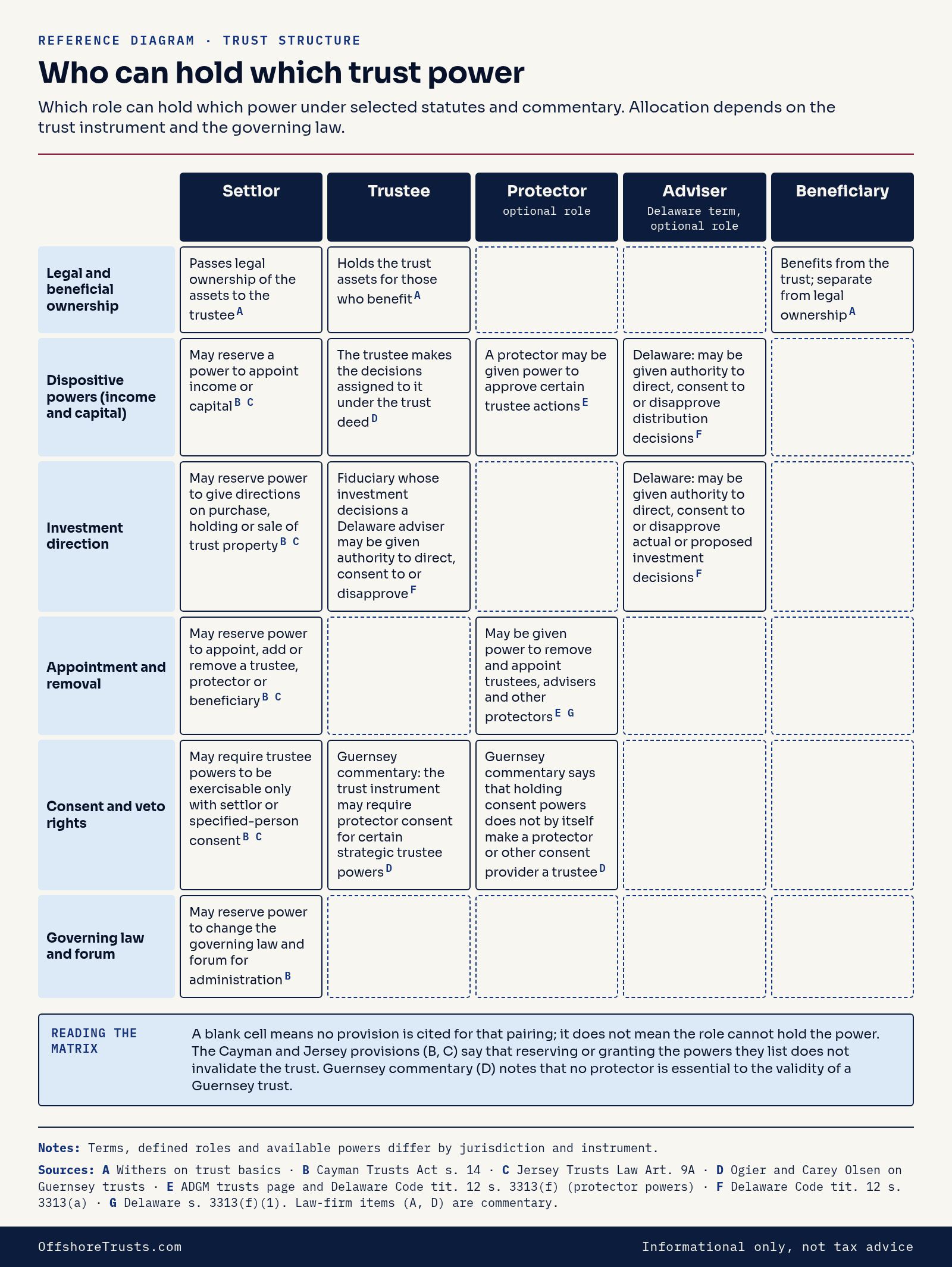
Data table for this infographic
| Power or topic | Settlor | Trustee | Protector | Investment adviser | Beneficiary |
|---|---|---|---|---|---|
| Legal and beneficial ownership | Passes legal ownership of the assets to the trustee A | Holds the trust assets for those who benefit A | Not covered | Not covered | Benefits from the trust; separate from legal ownership A |
| Dispositive powers (income and capital) | May reserve a power to appoint income or capital B C | The trustee makes the decisions assigned to it under the trust deed D | A protector may be given power to approve certain trustee actions E | Delaware: May be given authority to direct, consent to or disapprove distribution decisions F | Not covered |
| Investment direction | May reserve power to give directions on purchase, holding or sale of trust property B C | Fiduciary whose investment decisions a Delaware adviser may be given authority to direct, consent to or disapprove F | Not covered | Delaware: May be given authority to direct, consent to or disapprove actual or proposed investment decisions F | Not covered |
| Appointment and removal | May reserve power to appoint, add or remove a trustee, protector or beneficiary B C | Not covered | May be given power to remove and appoint trustees, advisers and other protectors E G | Not covered | Not covered |
| Consent and veto rights | May require trustee powers to be exercisable only with settlor or specified-person consent B C | Guernsey commentary: The trust instrument may require protector consent for certain strategic trustee powers D | Guernsey commentary says that holding consent powers does not by itself make a protector or other consent provider a trustee D | Not covered | Not covered |
| Governing law and forum | May reserve power to change the governing law and forum for administration B | Not covered | Not covered | Not covered | Not covered |
| Reading the matrix | A "Not covered" cell does not mean the role cannot hold the power. The Cayman and Jersey provisions (B, C) say that reserving or granting the powers they list does not invalidate the trust. Guernsey commentary (D) notes that no protector is essential to the validity of a Guernsey trust. Allocation depends on the trust instrument and the governing law. Terms, defined roles and available powers differ by jurisdiction and instrument. | ||||
| Notes and sources | Law-firm items (A, D) are commentary. A Withers on trust basics. B Cayman Trusts Act s. 14. C Jersey Trusts Law Art. 9A. D Ogier and Carey Olsen on Guernsey trusts. E ADGM trusts page and Delaware Code tit. 12 s. 3313(f) (protector powers). F Delaware Code tit. 12 s. 3313(a). G Delaware s. 3313(f)(1). | ||||
In more detail
A general Form 3520 filing rule covers a U.S. person who creates or transfers money or property to a foreign trust, or is treated as its owner under grantor trust rules.[4]
Key points
Under the Convention's definition, a settlor places assets under a trustee's control for a beneficiary or a specified purpose.[1]
Form 3520-A is the annual information return for a foreign trust with a U.S. owner.[4]
Related reading
For a broader account of trust structure, see What a trust means under U.S. and international law, which covers trust terms and structure. Foreign grantor trust explains the related ownership concept. Section 6048 reporting for certain foreign trusts covers foreign trust reporting. Section 679 and foreign trusts with U.S. beneficiaries focuses on the U.S. beneficiary connection.
Questions and answers
Can the trustee also be a beneficiary?
The Convention allows that possibility without necessarily changing the arrangement's status as a trust. It expressly recognizes that the trustee may also hold beneficiary rights.[1]
Does being named as a beneficiary determine U.S. beneficiary status?
Under the current IRS instructions, the Form 3520 definition generally includes a U.S. person who could benefit directly or indirectly. It applies even without designation in the instrument or an entitlement to a distribution during the reporting year.[3]
Can one trust have grantor and nongrantor portions?
Under the ownership rules, grantor treatment can apply to one portion of trust assets and nongrantor treatment to another.[3]
Does an owner report a foreign trust without transactions?
The instructions require Part II even without transactions during the reporting year. If the trust has not filed Form 3520-A, line 22 calls for a substitute Form 3520-A attached to the owner's filing.[3]
Does Form 3520 request information about discretionary beneficiaries?
Line 15 requests information about reportable beneficiaries, including discretionary classes and potential additions. This requirement applies within the specified Part I circumstances involving the absence of a U.S. agent.[3]
Related resources
Related glossary terms
- Foreign grantor trust: A foreign grantor trust is a foreign trust treated as owned by a grantor, often a U.S. person. Ownership brings Form 3520 and Form 3520-A reporting duties.
- Foreign grantor trust beneficiary statement: A foreign grantor trust beneficiary statement appears on page 5 of Form 3520-A. It reports distributions to U.S. beneficiaries and identifies the trust's owner.
Related articles and guides
- Trust Roles in FATCA and CRS Reporting: FATCA and CRS definitions cover people in named trust roles and others with effective control. Listed beneficiaries count whether or not they control the trust.
- Section 6048 reporting for certain foreign trusts: Section 6048 foreign trust reporting for U.S. citizens, including definitions and reportable events, as well as ownership and distributions and the IRS forms.
- How Trust Property Is Held Separately: A reference for U.S. citizens on how trust laws describe property held by trustees for beneficiaries or purposes, separate from the trustee's own estate.
Related pages
Sources and data notes
- Hague Conference on Private International Law, Convention of 1 July 1985 on the Law Applicable to Trusts and on their Recognition. https://www.hcch.net/en/instruments/conventions/full-text/?cid=59. Retrieved .
- U.S. Department of the Treasury; Office of the Federal Register, 26 CFR § 301.7701-4, Trusts. https://www.ecfr.gov/current/title-26/section-301.7701-4. Retrieved .
- Internal Revenue Service, Instructions for Form 3520 (12/2025): Annual Return To Report Transactions With Foreign Trusts and Receipt of Certain Foreign Gifts. https://www.irs.gov/instructions/i3520. Retrieved .
- advantagetaxlaw.com, Foreign Trust Reporting (Form 3520): Requirements, Penalties, and Relief Options, Advantage Tax Law. https://advantagetaxlaw.com/insights/foreign-trust-reporting-form-3520-penalties-requirements-and-defense-strategies/. Retrieved .
Dates in this block record when each source was read for this page.