
Section 679 and foreign trusts with U.S. beneficiaries
Section 679 covers ownership treatment, U.S. beneficiaries, transfer exceptions, and related reporting rules.
Terms used in Section 679
A U.S. citizen falls within the IRS definition of a U.S. person. That definition also includes U.S. residents, domestic partnerships, domestic corporations, and certain estates and trusts.[2]
For Section 679, the transferor is the U.S. person transferring property, directly or indirectly, to the foreign trust. Ownership treatment applies to the trust portion attributable to that property when the statutory conditions are met.[1]
A U.S. beneficiary can include someone whose interest depends on a future event. Section 679 expressly counts amounts accumulated for that person's benefit even when the interest is contingent.[1]
How the ownership rule works
Section 679 treats a U.S. transferor as owner of the attributable trust portion when any portion has a U.S. beneficiary for the taxable year. The rule covers direct and indirect property transfers and excludes the category of trust identified in section 6048(a)(3)(B)(ii).[1]
The IRS places Section 679 within the grantor trust rules in sections 671 through 679. A U.S. person treated as owner under those rules is taxed on the trust's income.[2]
The Foreign Grantor Trust Owner Statement supplies information about trust income reportable on the owner's U.S. income tax return. The IRS identifies that statement as part of Form 3520-A.[2]
When a trust has a U.S. beneficiary
Section 679 generally treats a trust as having a U.S. beneficiary unless both statutory restrictions are satisfied. The trust terms must preclude paying or accumulating income or principal for a U.S. person's benefit during the taxable year.[1]
The second restriction addresses termination. If the trust terminated at any point during the taxable year, none of its income or principal could be paid to or for a U.S. person's benefit.[1]
Discretion to select recipients also affects this test. Where a person can direct distributions to anyone, the statute treats the trust as having a U.S. beneficiary unless its terms identify the permitted class and none of that class are U.S. persons during the taxable year.[1]
An agreement involving a U.S. transferor can count as a trust term if it may result in income or principal benefiting a U.S. person. This includes oral agreements and understandings.[1]
Loans and use of trust property
A trust loan or use of trust property can count as a payment or accumulation for a U.S. person's benefit under Section 679. The provision covers cash or marketable securities loans and use of other trust property, including by someone unnamed as a beneficiary.[1]
Under the proposed regulations, an exception may apply to a cash loan made in exchange for a qualified obligation, or to use of other trust property to the extent the trust receives fair market value within 60 days from the start of the use.[1]
Exceptions and changes in status
Section 679 excludes transfers caused by the transferor's death and transfers for payment worth at least the property's fair market value. Noncash payment is measured at fair market value.[1]
Special limits govern counting obligations toward the fair market value exception for transfers by grantors, owners, beneficiaries, or specified related persons. Subject to regulatory qualifications, obligations of the trust or those persons are excluded from that calculation.[1]
A beneficiary is disregarded as a U.S. person for a particular transfer if that beneficiary first becomes a U.S. person more than five years after the transfer.[1]
A domestic trust's change to foreign status can also trigger the transfer rules. If a U.S. citizen or resident previously transferred property and remains alive when the trust becomes foreign, sections 679 and 6048 treat the attributable portion as transferred at that change.[1]
How ownership connects to U.S. reporting
Form 3520 generally applies when a U.S. person is treated as owner under the grantor trust rules. The IRS also lists creating or funding a foreign trust, lending to it, and receiving distributions, loans, or uncompensated property use as filing triggers.[2]
The IRS assigns U.S. owners responsibility for ensuring a timely, complete, accurate Form 3520-A and required annual statements. If the trust does not file, the owner has a substitute filing obligation through the owner's timely Form 3520.[2]
Reporting exceptions include Canadian registered retirement savings plans and registered retirement income funds. Conditional reporting exceptions exist for certain foreign trusts providing retirement, medical, disability, or educational benefits, subject to eligibility and trust requirements.[2]
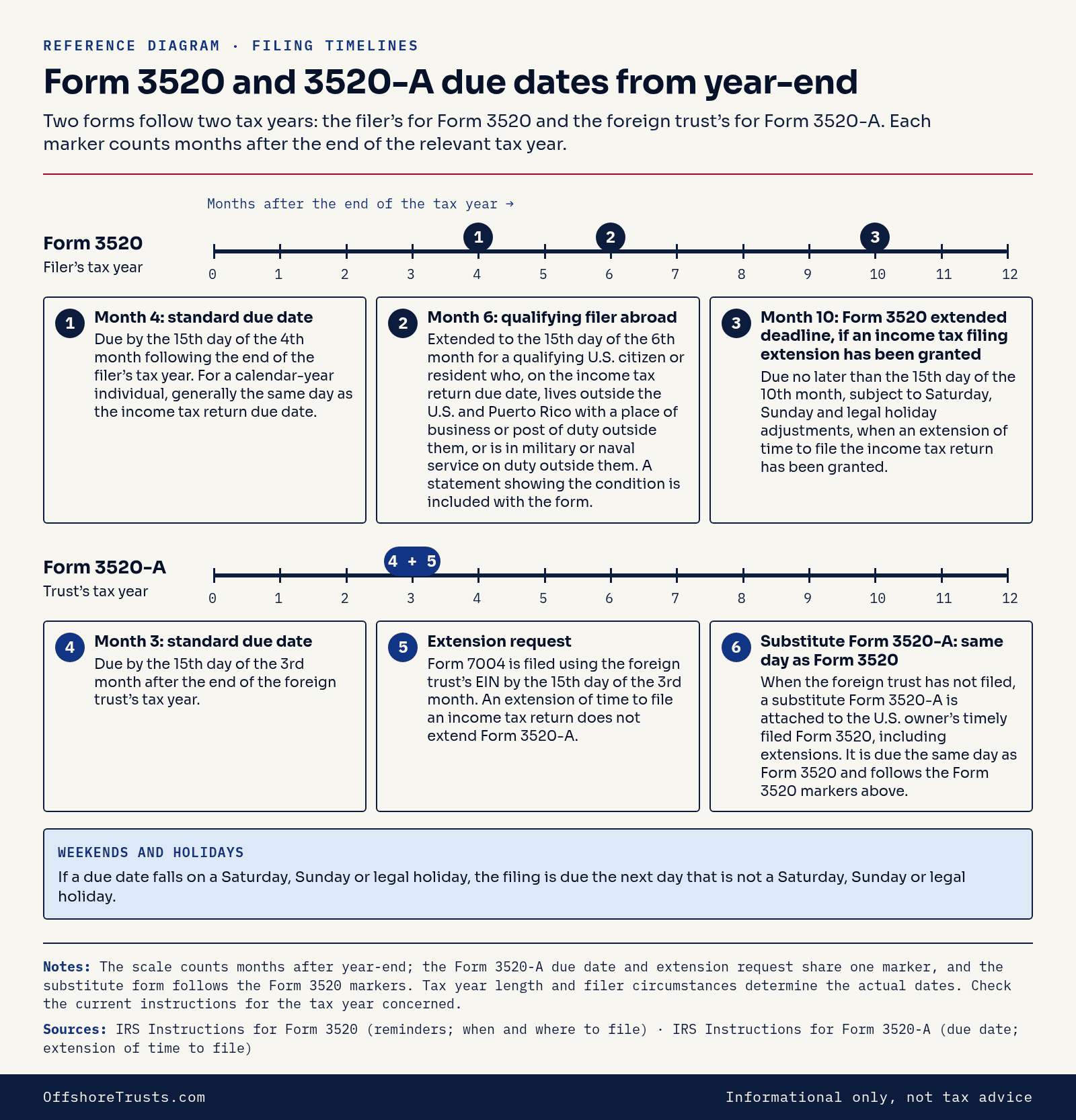
Data table for this infographic
| Form | Tax year used | Due date or condition | Description |
|---|---|---|---|
| Form 3520 | The filer's own tax year | Month 4: standard due date | Due by the 15th day of the 4th month following the end of the filer's tax year. For a calendar-year individual, generally the same day as the income tax return due date. |
| Form 3520 | The filer's own tax year | Month 6: qualifying filer abroad | Extended to the 15th day of the 6th month for a qualifying U.S. citizen or resident who, on the income tax return due date, lives outside the U.S. and Puerto Rico with a place of business or post of duty outside them, or is in military or naval service on duty outside them. A statement showing the condition is included with the form. |
| Form 3520 | The filer's own tax year | Month 10: Form 3520 extended deadline, if an income tax filing extension has been granted | Due no later than the 15th day of the 10th month, subject to Saturday, Sunday and legal holiday adjustments, when an extension of time to file the income tax return has been granted. |
| Form 3520-A | The foreign trust's tax year | Month 3: standard due date | Due by the 15th day of the 3rd month after the end of the foreign trust's tax year. |
| Form 3520-A | The foreign trust's tax year | Extension request | Form 7004 is filed using the foreign trust's EIN by the 15th day of the 3rd month. An extension of time to file an income tax return does not extend Form 3520-A. |
| Substitute Form 3520-A | Follows the filer's Form 3520 timeline | Same day as Form 3520 | When the foreign trust has not filed, a substitute Form 3520-A is attached to the U.S. owner's timely filed Form 3520, including extensions. It is due the same day as Form 3520 and follows the Form 3520 markers above. |
| All forms | The tax year that applies to each form | Weekends and holidays | If a due date falls on a Saturday, Sunday or legal holiday, the filing is due the next day that is not a Saturday, Sunday or legal holiday. |
| Notes | The filer's or the foreign trust's tax year, depending on the form | Scope | The scale counts months after year-end; the Form 3520-A due date and extension request share one marker, and the substitute form follows the Form 3520 markers. Tax year length and filer circumstances determine the actual dates. The instructions for the tax year concerned govern. |
Questions and answers
Does a U.S. beneficiary need to receive a distribution?
Section 679's beneficiary test includes permitted payments and accumulations under the trust terms. An interest dependent on a future event can count.[1]
Can the IRS presume a foreign trust has a U.S. beneficiary?
Section 679 permits that presumption after a covered U.S. transfer. The statutory exception requires requested transfer information and a demonstration satisfactory to the Secretary that both beneficiary restrictions are satisfied.[1]
Does Form 3520 replace Form 3520-A?
The IRS describes separate reporting responsibilities for the two forms. When the trust does not file Form 3520-A, its U.S. owner attaches a substitute to a timely Form 3520.[2]
Can other U.S. reporting forms apply?
The IRS identifies Schedule B, Part III, for foreign trust distributions, grantors, and transferors. Form 8938 may apply where specified foreign financial assets exceed the applicable reporting thresholds.[2]
Related resources
Related glossary terms
- Transfer to a foreign trust: Form 3520 covers direct and indirect transfers of money or property to a foreign trust, including gratuitous transfers, alongside the U.S. ownership rules.
- Distribution from a foreign trust: A foreign trust distribution triggers section 6048(c) reporting for the U.S. person who receives it.
- Adverse party: Section 672 defines an adverse party by reference to a substantial beneficial interest in a trust and the effect of a power held over it in the trust.
Related articles and guides
- 26 U.S.C. § 679, foreign trusts with U.S. beneficiaries: 26 U.S.C. § 679 sets an ownership rule for foreign trusts with U.S. beneficiaries, defines a U.S. beneficiary and is linked to section 6048 reporting.
- When a Foreign Trust Has a U.S. Beneficiary: A foreign trust is generally treated as having a U.S. beneficiary unless its terms preclude any income or principal from benefiting a U.S. person. Rules also address trust terms, loans, property use, and transfer reporting.
- Foreign trust loans and use of property: For a U.S. citizen, IRS instructions treat certain loans from a related foreign trust and uncompensated use of trust property as reportable distributions.
Related pages
Sources and data notes
- United States Congress, Office of the Law Revision Counsel, 26 U.S.C. § 679, Foreign trusts having one or more United States beneficiaries. https://uscode.house.gov/us/usc/119-118/t26/s679/. Retrieved .
- Internal Revenue Service, Foreign trust reporting requirements and tax consequences. https://www.irs.gov/businesses/international-businesses/foreign-trust-reporting-requirements-and-tax-consequences. Retrieved .
Dates in this block record when each source was read for this page.