
Form 3520: foreign trusts and foreign gifts
Form 3520 reports transactions with foreign trusts and certain gifts from foreign persons, and its instructions cover categories, definitions, attachments and timing.
What Form 3520 reports
Form 3520 covers certain foreign trust transactions, ownership under sections 671 through 679, and receipts of certain large foreign gifts or bequests. The IRS describes its filers as U.S. persons and executors handling estates of deceased U.S. persons.[1]
The instructions divide reporting among four parts. Part I addresses transfers and reportable events, Part II addresses ownership, Part III addresses distributions and specified related transactions, and Part IV addresses foreign gifts and bequests meeting the reporting conditions.[2]
The instructions require a separate return for each foreign trust. They permit spouses to submit a joint Form 3520 when the spouses file a joint income tax return and both are transferors, grantors or beneficiaries of that same trust.[2]
Who falls within the reporting categories
A U.S. citizen falls within the IRS definition of a U.S. person. The definition also includes U.S. residents, domestic partnerships and corporations, estates other than foreign estates, and trusts meeting the domestic trust conditions.[3]
Part I applies to the responsible party reporting a reportable event. It also applies to specified transfers to a related foreign trust or related person in exchange for an obligation, and to holders of outstanding qualified obligations covered by the instructions.[2]
Part II applies when a U.S. person is treated as owning any portion of a foreign trust's assets under sections 671 through 679 during the tax period. The instructions require this part even when the trust had no transactions during that period.[2]
Part III covers direct and indirect foreign trust distributions received by U.S. persons, including U.S. owners, and specified estate executors. Its reporting categories also include certain loans, uncompensated use of trust property, and outstanding qualified obligations involving U.S. owners, beneficiaries or related U.S. persons.[2]
Definitions used in the instructions
A trust is foreign when it fails to meet the domestic trust definition. Domestic status requires both U.S. judicial supervision over trust administration and authority held by one or more U.S. persons over every substantial trust decision.[2]
An owner is a person treated as owning foreign trust assets under sections 671 through 679. Grantor trust status applies to the extent that someone other than the trust is treated as owning its assets, so this classification can apply to only part of a trust.[2]
A nongrantor trust is treated as a separate taxable entity to the extent its assets are not attributed to another person under those grantor trust rules. The instructions define property broadly enough to include cash and both tangible and intangible property.[2]
Reportable events include a U.S. person's creation of a foreign trust and direct or indirect transfers of money or property to one. A U.S. citizen's or resident's death also qualifies when the deceased owned a trust portion under the specified rules or a portion was included in the gross estate.[2]
A distribution can arise without a direct cash payment to the recipient. The instructions include constructive transfers, such as trust payment of personal credit card charges or checks drawn on a trust account. Payments exceeding the fair market value of property or services provided to the trust also produce a distribution for the excess.[2]
Information and attachments for transfers and ownership
The identifying information distinguishes individual taxpayer numbers from entity numbers. Individuals are identified with SSNs or ITINs, while trusts and estates use EINs, as do partnerships and corporations. For the foreign trust on line 2b, the instructions specify an EIN.[2]
Part I requests the trust creator's name and address, as well as taxpayer number, if any. Its transfer schedule distinguishes tangible from intangible property and asks for the property's U.S. adjusted basis. Cash transfers during the reporting period may be combined on one line.[2]
For a Part I filer, the absence of an appointed U.S. agent able to supply relevant trust information triggers lines 15 through 18. Those lines request beneficiary information and details of persons with significant trust powers, including descriptions of those powers.[2]
The associated attachments include a summary of trust terms and oral understandings, trust documents and revisions, financial statements, and an organizational chart showing ownership percentages. When these documents accompanied Form 3520 or Form 3520-A within the preceding three years, the instructions request relevant updates only.[2]
Part II requests information about each person treated as an owner and the Code provision creating that treatment. Line 23 reports the fair market value of assets attributed to the filer at the reporting period's end, with liabilities disregarded.[2]
Distribution statements and foreign gifts
Part III requests cash received and the fair market value of other property received, whether taxable or otherwise. Loans and uncompensated property use are reported separately on line 25. An amount reportable under both Parts III and IV belongs in Part III.[2]
A complete Foreign Grantor Trust Beneficiary Statement accompanies a yes response on line 29. For that distribution, the instructions end further Part III calculations. The statement includes identifying information, an explanation of ownership treatment, and details of distributed property and its fair market value.[2]
A Foreign Nongrantor Trust Beneficiary Statement accompanies a yes response on line 30. It supplies the tax treatment of distributions or information sufficient to establish that treatment. Schedule B calculations require this statement and generally require that Schedule A has never been used for that trust, except in its termination period.[2]
Part IV's individual and foreign estate reporting category begins above $100,000 of receipts treated as gifts or bequests. Aggregation applies where the recipient knows or has reason to know that donors are related, or that one acts as another's nominee or intermediary.[2]
Gifts treated as received from foreign corporations or partnerships use the separate section 6039F threshold, which the instructions direct readers to the IRS inflation adjustment material to obtain. Qualified tuition and medical payments made on a U.S. person's behalf are excluded from the gift definition used here.[2]
How Form 3520 relates to other returns
Form 3520-A supplies information about a foreign trust with a U.S. owner. Part II of Form 3520 requests the Foreign Grantor Trust Owner Statement when the trust files Form 3520-A, or a substitute Form 3520-A when the trust has not filed it.[2][3]
Other reporting can apply alongside Form 3520, including Form 8938 and FBAR. The IRS also identifies Schedule B of Form 1040 for foreign trust distributions, grantors and transferors. Completed gifts to a trust may involve Form 709, while a bequest may involve Form 706.[2][3]
The instructions identify Form 8082 for reporting tax return treatment that differs from the trust's Form 3520-A treatment. They also identify Form 8865 where transferred assets are treated as owned by a foreign partnership and direct-transfer reporting rules apply.[2]
Filing timing and stated exceptions
The general Form 3520 deadline is day 15 of the fourth month after the filer's tax period ends. An income tax filing extension extends Form 3520 no further than day 15 of the tenth month after that period ends.[2]
A deadline of day 15 of the sixth month applies to qualifying citizens and residents living and working outside both the United States and Puerto Rico, and to qualifying military or naval personnel serving outside those places. The instructions require an accompanying statement establishing the relevant condition.[2]
A substitute Form 3520-A shares the owner's Form 3520 deadline and is attached to it with the required owner and beneficiary statements. The ordinary Form 3520-A deadline is day 15 of the third month after the foreign trust's tax period ends. When that day falls on a weekend or legal holiday, the due date moves to the next business day.[2]
The instructions list exceptions for specified Canadian retirement arrangements and certain eligible individuals' transactions with qualifying retirement or savings trusts under the cited revenue procedures. These exceptions retain their stated eligibility conditions and do not remove other reporting obligations.[2]
Penalties for late or incomplete filing
The Form 3520 penalties are large because they are measured against the assets involved, not against tax owed. The initial penalty under section 6677 is the greater of $10,000 or a percentage of gross value: 35% of property transferred to a foreign trust that was not reported, 35% of distributions received that were not reported, and, for a U.S. owner, 5% of the gross value of the portion of the trust treated as owned when the foreign trust does not file a timely, complete Form 3520-A. More penalties can follow if the failure continues more than 90 days after the IRS mails a notice.[2]
A late or missing report of a foreign gift carries its own penalty: 5% of the gift for each month the failure continues, up to 25%, and the IRS may determine the income tax consequences of the receipt itself. A separate rule can raise the 20% accuracy-related penalty to 40% for an underpayment tied to an asset that was required to be reported on Form 3520-A but was not.[2]
Reasonable cause is the defense, and the instructions close off the usual excuses. A foreign country's penalty for disclosing information, a foreign fiduciary's reluctance to disclose, and trust-instrument terms that prevent disclosure are not reasonable cause.
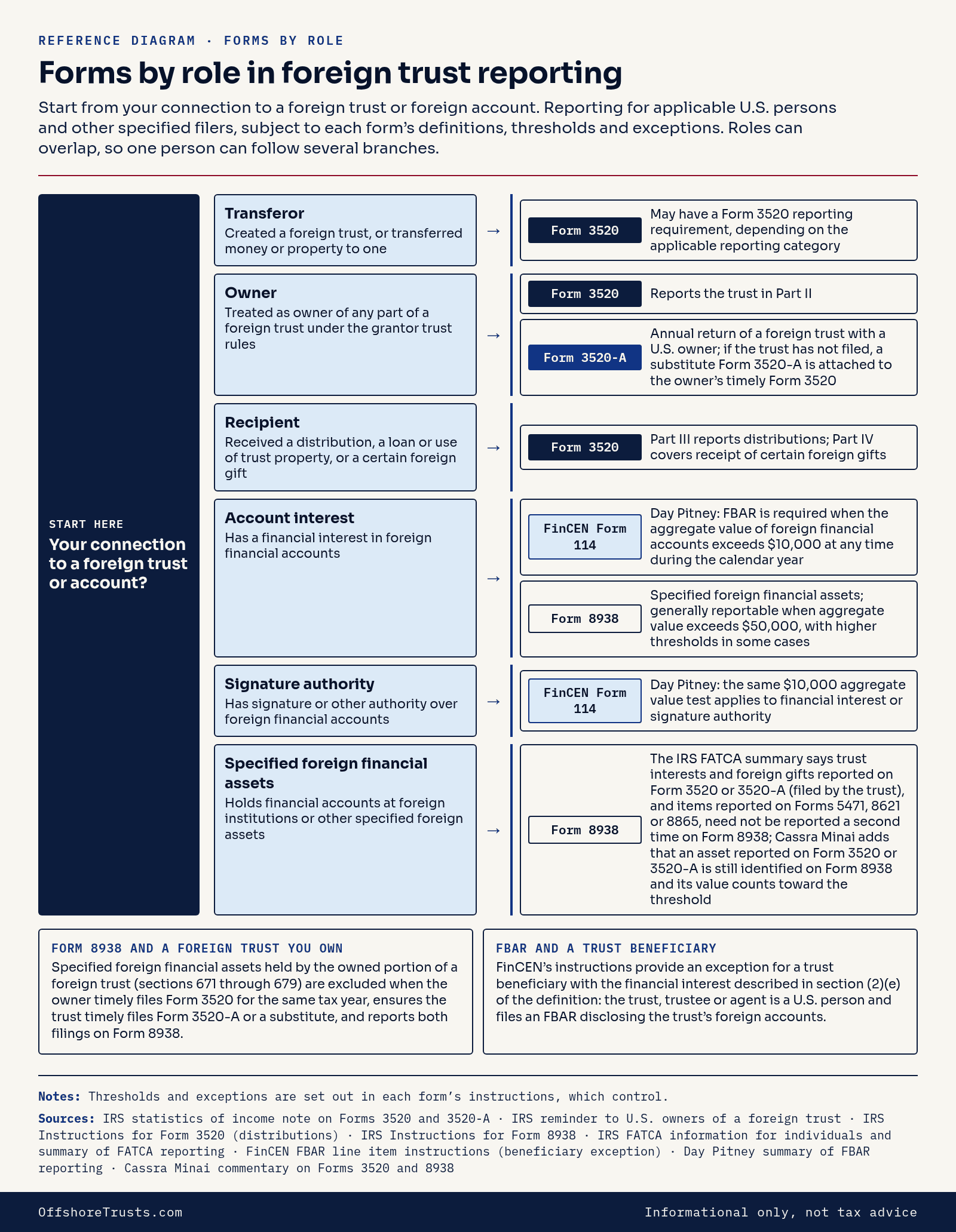
Data table for this infographic
| Role or topic | Connection or condition | Form or reporting | Details |
|---|---|---|---|
| Start here | Your connection to a foreign trust or account? | Roles can overlap, so one person can follow several branches. | |
| Transferor | Created a foreign trust, or transferred money or property to one | Form 3520 | May have a Form 3520 reporting requirement, depending on the applicable reporting category |
| Owner | Treated as owner of any part of a foreign trust under the grantor trust rules | Form 3520 | Reports the trust in Part II |
| Owner | Treated as owner of any part of a foreign trust under the grantor trust rules | Form 3520-A | Annual return of a foreign trust with a U.S. owner; if the trust has not filed, a substitute Form 3520-A is attached to the owner's timely Form 3520 |
| Recipient | Received a distribution, a loan or use of trust property, or a certain foreign gift | Form 3520 | Part III reports distributions; Part IV covers receipt of certain foreign gifts |
| Account interest | Has a financial interest in foreign financial accounts | FinCEN Form 114 | Day Pitney: FBAR is required when the aggregate value of foreign financial accounts exceeds $10,000 at any time during the calendar year |
| Account interest | Has a financial interest in foreign financial accounts | Form 8938 | Specified foreign financial assets; generally reportable when aggregate value exceeds $50,000, with higher thresholds in some cases |
| Signature authority | Has signature or other authority over foreign financial accounts | FinCEN Form 114 | Day Pitney: the same $10,000 aggregate value test applies to financial interest or signature authority |
| Specified foreign financial assets | Holds financial accounts at foreign institutions or other specified foreign assets | Form 8938 | Trust interests and foreign gifts reported on Form 3520 or 3520-A, and items reported on Forms 5471, 8621 or 8865, need not be reported a second time on Form 8938. The asset is still identified on Form 8938, and its value counts toward the threshold. |
| Form 8938 and a foreign trust you own | Treated as owner of any part of a foreign trust under the grantor trust rules | Form 8938 | Specified foreign financial assets held by the owned portion of a foreign trust (sections 671 through 679) are excluded when the owner timely files Form 3520 for the same tax year, ensures the trust timely files Form 3520-A or a substitute, and reports both filings on Form 8938. |
| FBAR and a trust beneficiary | Trust beneficiary with a financial interest in the trust's foreign financial accounts | FinCEN Form 114 | FinCEN's instructions provide an exception for a trust beneficiary with the financial interest described in section (2)(e) of the definition: the trust, trustee or agent is a U.S. person and files an FBAR disclosing the trust's foreign accounts. |
Notes: Thresholds and exceptions are set out in each form’s instructions, which control.
Sources: IRS statistics of income note on Forms 3520 and 3520-A · IRS reminder to U.S. owners of a foreign trust · IRS Instructions for Form 3520 (distributions) · IRS Instructions for Form 8938 · IRS FATCA information for individuals and summary of FATCA reporting · FinCEN FBAR line item instructions (beneficiary exception) · Day Pitney summary of FBAR reporting · Cassra Minai commentary on Forms 3520 and 8938 · OffshoreTrusts.com
Questions and answers
Does ownership alone bring a U.S. citizen within Part II?
Part II applies when the citizen is treated as owning foreign trust assets under sections 671 through 679. The instructions require it even without transactions during the reporting period.[2]
Can spouses report the same foreign trust jointly?
The instructions permit a joint Form 3520 when spouses file a joint income tax return and both have the specified connection to the same trust. The joint filing box is on line 1i.[2]
Where does a foreign trust distribution described as a gift belong?
The instructions assign foreign trust distributions to Part III. An amount falling within both the distribution and gift reporting categories is reported there only.[2]
Which taxpayer number identifies the foreign trust?
The instructions specify the trust's EIN on line 2b. They exclude an SSN or ITIN from that entry.[2]
Related resources
Related glossary terms
- Substitute Form 3520-A: A substitute Form 3520-A is filed by a U.S. owner when a foreign trust fails to file its annual return, and it carries its own timing and statement rules.
- Reporting financial institution: The Common Reporting Standard classifies a financial institution as reporting when it falls within the relevant jurisdiction's rules and is not non-reporting.
- FBAR: FinCEN describes the FBAR filing rule for U.S. persons with foreign accounts. It covers the $10,000 aggregate threshold, account interests and exceptions.
Related articles and guides
- Tax planning and compliance for foreign trusts: U.S. rules classify trusts and assign tax and reporting duties to U.S. citizens connected with foreign trusts, including forms, filing calendars and records.
- The court and control tests for foreign trusts: The court test and the control test classify a trust as domestic or foreign, and foreign trust status connects to U.S. reporting rules for U.S. citizens.
Tools and official documents
- Form 5471: information return for foreign corporations: Form 5471 reports U.S. persons' interests in foreign corporations: reporting categories, ownership definitions, schedules, related forms and filing timing.
Related pages
- IRS forms: All form reference pages.
- FinCEN Report 114 (FBAR): foreign account reporting
- Form 1041: income tax return for estates and trusts
- Form 1116: foreign tax credit
- Form 2555: foreign earned income exclusion
- IRS form finder: Search the forms by keyword.
- Expatriation, exit tax and gifts from covered expatriates: Expatriation for U.S. citizens: covered status and exit tax, trust interests and reporting, and the tax on gifts and bequests received by U.S. persons.
Sources and data notes
- Internal Revenue Service, About Form 3520. https://www.irs.gov/forms-pubs/about-form-3520. Retrieved .
- Internal Revenue Service, Instructions for Form 3520. https://www.irs.gov/instructions/i3520. Retrieved .
- Internal Revenue Service, Foreign trust reporting requirements and tax consequences. https://www.irs.gov/businesses/international-businesses/foreign-trust-reporting-requirements-and-tax-consequences. Retrieved .
Dates in this block record when each source was read for this page.