
Grantor trust rules in sections 671 to 679
Grantor trust rules cover definitions, ownership tests, foreign trust beneficiaries, and statutory links to U.S. reporting rules.
Definitions come first
Section 672 defines an adverse party by a substantial beneficial interest that the exercise or nonexercise of a trust power would adversely affect. A nonadverse party is anyone outside that definition.[1]
A related or subordinate party is a nonadverse party within specified family, employment, or corporate relationships. The listed family relationships include a spouse living with the grantor, parents, descendants, and siblings.[1]
For section 672(f) and sections 674 and 675, a related or subordinate party is presumed subservient to the grantor unless a preponderance of evidence establishes otherwise. Section 672 also attributes specified spousal powers and interests to the grantor, including powers created before marriage for periods after the marriage begins.[1]
How the ownership tests fit together
The ownership tests address specified portions of a trust. Section 674 addresses control over beneficial enjoyment, section 675 addresses administrative powers, and section 676 addresses powers that can return title to the grantor.[2][3][4]
Section 677 addresses income available for the grantor or spouse, while section 678 can assign ownership to someone other than the grantor. Section 679 addresses property transferred by a United States person to a foreign trust with a United States beneficiary.[5][6][7]
Control over beneficial enjoyment
Section 674 generally assigns ownership where the grantor or a nonadverse party can determine beneficial enjoyment of trust property or income without an adverse party's approval. Its exceptions depend on the particular power and its limits.[2]
One exception covers distributions of trust principal to beneficiaries under a reasonably definite standard written into the trust instrument. Another covers allocating receipts and disbursements between principal and income, including broadly expressed allocation powers.[2]
Section 674(c) provides an exception for specified distribution powers held solely by trustees, none of whom is the grantor and no more than half of whom are related or subordinate parties subservient to the grantor. A power to add beneficiaries generally prevents that exception, with an exception for children born or adopted afterward.[2]
Administrative powers and borrowing
Section 675 assigns ownership under specified transaction, borrowing, and administrative conditions. One trigger is a power permitting dealings with trust property for inadequate monetary value, exercisable by the grantor or a nonadverse party without an adverse party's approval.[3]
A borrowing power without adequate interest or security also falls within section 675, subject to an exception for a trustee other than the grantor exercising a general lending power. Actual borrowing that remains unpaid, including interest, at the start of the taxable year is a separate trigger, with an exception for adequately secured, adequately interest-bearing loans from specified trustees.[3]
Specified administrative powers trigger ownership when exercisable in a nonfiduciary capacity without approval from anyone acting in a fiduciary capacity. These include reacquiring trust principal through substitution of property of equivalent value.[3]
Revocation and income for the grantor
Section 676 assigns ownership when the grantor, a nonadverse party, or both can return title to a trust portion to the grantor. A conditional exception addresses powers affecting income enjoyment only after an event linked to section 673's reversionary-interest test.[4]
Section 677 covers income that can reach the grantor or spouse without an adverse party's approval, including amounts retained for later distribution. It also covers certain life insurance premiums, except policies irrevocably payable for a purpose specified in section 170(c).[5]
A discretionary power to support a beneficiary other than the spouse does not alone make the income taxable to the grantor under section 677(b). Where the grantor has a legal support obligation, the exception extends only to income that has not actually been used for that support.[5]
Ownership by someone other than the grantor
Section 678 can treat another person as owner when that person alone can vest trust principal or income in themselves. It also addresses partial releases or modifications where sufficient control remains under the principles of sections 671 to 677.[6]
The rule does not apply to an income power where the grantor or a section 679 transferor is otherwise treated as owner under another provision of the subpart. A power renounced or disclaimed within a reasonable time after its holder learns of it also falls outside section 678(a).[6]
Foreign trusts and United States beneficiaries
Section 679 generally assigns ownership to a United States transferor where a foreign trust has a United States beneficiary during the taxable year, excluding trusts described in section 6048(a)(3)(B)(ii). Ownership attaches to the portion attributable to the transferred property.[7]
Exceptions cover transfers resulting from death and exchanges for at least fair market value. Special rules restrict which obligations count toward the exchange value.[7]
A foreign trust is treated as having a United States beneficiary if income or principal may benefit a United States person during the taxable year, including upon termination during that year; an interest dependent on a future event can still count.[7]
The statutory connection to reporting
Section 679 expressly connects certain deemed transfers with section 6048. If a citizen or resident transferred property to a domestic trust that becomes foreign during that person's lifetime, both sections apply as though the attributable portion were transferred when the trust became foreign.[7]
Section 679(d) also links beneficiary treatment to information submitted to the Secretary. Its presumption can apply unless the transferor supplies required transfer information and demonstrates that both statutory conditions excluding United States beneficiaries are satisfied.[7]
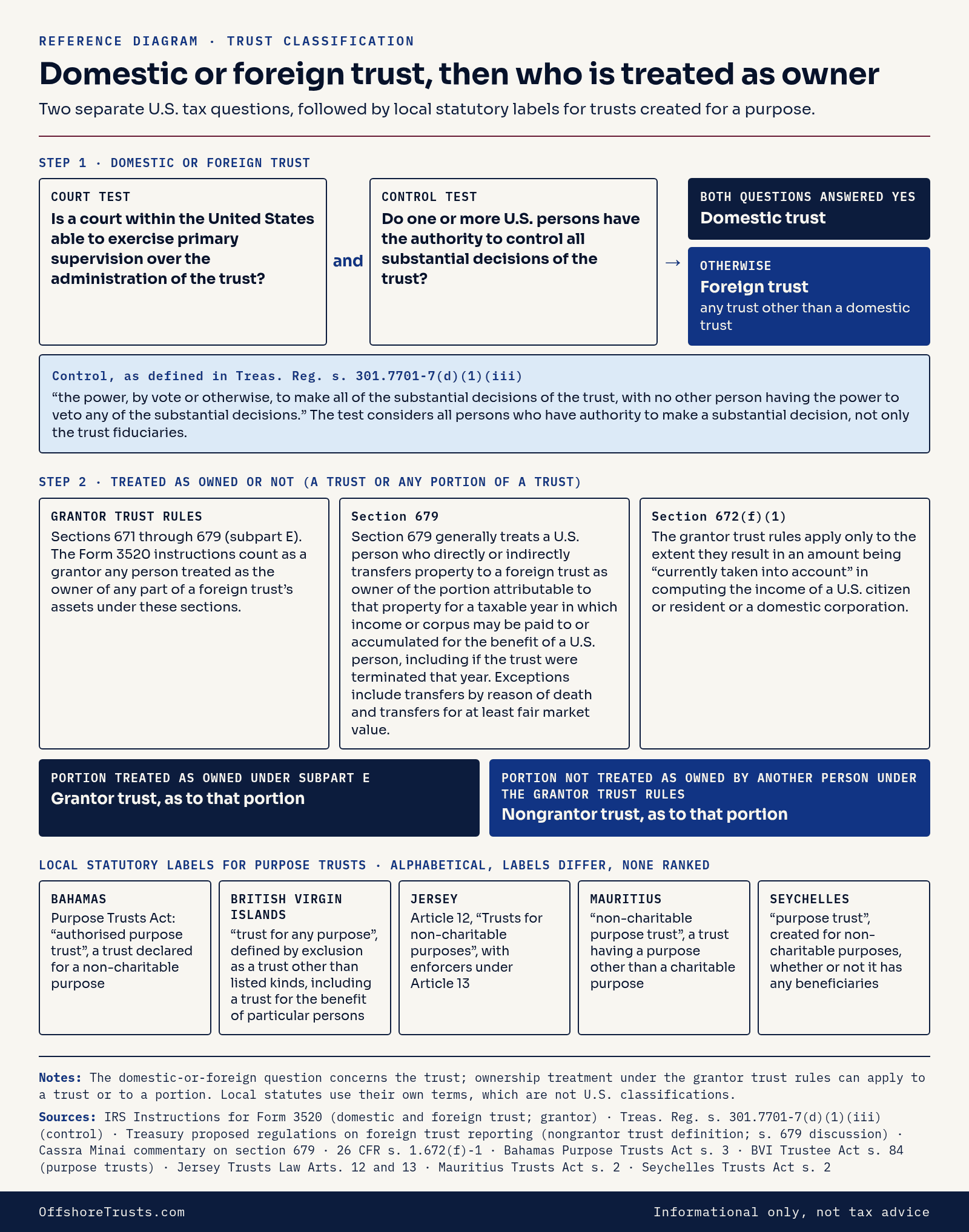
Data table for this infographic
| Group | Question or label | Description or rule | Result or source |
|---|---|---|---|
| Reference diagram · Trust classification | Domestic or foreign trust, then who is treated as owner | Two separate U.S. tax questions, followed by local statutory labels for trusts created for a purpose. | |
| Step 1 · Domestic or foreign trust | Court test | Is a court within the United States able to exercise primary supervision over the administration of the trust? | |
| Step 1 · Domestic or foreign trust | Control test | Do one or more U.S. persons have the authority to control all substantial decisions of the trust? | |
| Step 1 · Domestic or foreign trust | Both questions answered yes | Domestic trust | |
| Step 1 · Domestic or foreign trust | Otherwise | Foreign trust, any trust other than a domestic trust | |
| Control, as defined in Treas. Reg. s. 301.7701-7(d)(1)(iii) | Control | "the power, by vote or otherwise, to make all of the substantial decisions of the trust, with no other person having the power to veto any of the substantial decisions." The test considers all persons who have authority to make a substantial decision, not only the trust fiduciaries. | Treas. Reg. s. 301.7701-7(d)(1)(iii) |
| Step 2 · Treated as owned or not (a trust or any portion of a trust) | Grantor trust rules | Sections 671 through 679 (subpart E). The Form 3520 instructions count as a grantor any person treated as the owner of any part of a foreign trust's assets under these sections. | |
| Step 2 · Treated as owned or not (a trust or any portion of a trust) | Section 679 | Section 679 generally treats a U.S. person who directly or indirectly transfers property to a foreign trust as owner of the portion attributable to that property for a taxable year in which income or corpus may be paid to or accumulated for the benefit of a U.S. person, including if the trust were terminated that year. Exceptions include transfers by reason of death and transfers for at least fair market value. | |
| Step 2 · Treated as owned or not (a trust or any portion of a trust) | Section 672(f)(1) | The grantor trust rules apply only to the extent they result in an amount being "currently taken into account" in computing the income of a U.S. citizen or resident or a domestic corporation. | |
| Step 2 · Treated as owned or not (a trust or any portion of a trust) | Portion treated as owned under subpart E | Grantor trust, as to that portion | |
| Step 2 · Treated as owned or not (a trust or any portion of a trust) | Portion not treated as owned by another person under the grantor trust rules | Nongrantor trust, as to that portion | |
| Local statutory labels for purpose trusts · alphabetical, labels differ, none ranked | Bahamas | Purpose Trusts Act: "authorised purpose trust", a trust declared for a non-charitable purpose | statute |
| Local statutory labels for purpose trusts · alphabetical, labels differ, none ranked | British Virgin Islands | "trust for any purpose", defined by exclusion as a trust other than listed kinds, including a trust for the benefit of particular persons | statute |
| Local statutory labels for purpose trusts · alphabetical, labels differ, none ranked | Jersey | Article 12, "Trusts for non-charitable purposes", with enforcers under Article 13 | statute |
| Local statutory labels for purpose trusts · alphabetical, labels differ, none ranked | Mauritius | "non-charitable purpose trust", a trust having a purpose other than a charitable purpose | statute |
| Local statutory labels for purpose trusts · alphabetical, labels differ, none ranked | Seychelles | "purpose trust", created for non-charitable purposes, whether or not it has any beneficiaries | statute |
| Notes | Commentary and statute | The domestic-or-foreign question concerns the trust; ownership treatment under the grantor trust rules can apply to a trust or to a portion. Local statutes use their own terms, which are not U.S. classifications. | commentary |
| Sources | U.S. sources | IRS Instructions for Form 3520 (domestic and foreign trust; grantor) · Treas. Reg. s. 301.7701-7(d)(1)(iii) (control) · Treasury proposed regulations on foreign trust reporting (nongrantor trust definition; s. 679 discussion) · Cassra Minai commentary on section 679 · 26 CFR s. 1.672(f)-1 | |
| Sources | Local statute sources | Bahamas Purpose Trusts Act s. 3 · BVI Trustee Act s. 84 (purpose trusts) · Jersey Trusts Law Arts. 12 and 13 · Mauritius Trusts Act s. 2 · Seychelles Trusts Act s. 2 | |
Questions and answers
Does ownership treatment always cover the whole trust?
The statutes frame ownership by reference to a trust portion. Section 679 ties that portion to the property transferred.[2][7]
Can a spouse's power count as the grantor's power?
Section 672 attributes specified spousal powers and interests to the grantor. For someone who marries the grantor after the power is created, attribution applies to periods after the marriage begins.[1]
Does a notice requirement remove a trust power?
Section 672 treats a person as holding a covered power despite a prior notice requirement. The same rule applies when exercise takes effect after a specified waiting period.[1]
Can using foreign trust property count as a benefit?
Section 679 includes loans of cash or marketable securities and use of other trust property in its beneficiary rule. An exception applies to timely repayment with market interest or payment of fair market value for use.[7]
Related resources
Related glossary terms
- Power to control beneficial enjoyment: Section 674 describes when control over trust benefits causes a grantor to be treated as owner of a trust portion. The rule concerns beneficial enjoyment.
- Domestic trust: The IRS defines a domestic trust through its court test and control test, and the term appears in U.S. foreign trust reporting rules for U.S. citizens.
- Administrative powers (grantor trust): Section 675 of the Internal Revenue Code describes administrative powers that can cause a grantor to be treated as owner of a trust portion, with limits.
Related articles and guides
- The court and control tests for foreign trusts: The court test and the control test classify a trust as domestic or foreign, and foreign trust status connects to U.S. reporting rules for U.S. citizens.
- 26 U.S.C. § 674, Power to control beneficial enjoyment: Section 674 treats a grantor as owner of part of a trust when the grantor or another person controls who enjoys principal or income, subject to exceptions.
- 26 U.S.C. § 677, Income for benefit of grantor: 26 U.S.C. § 677 addresses when a grantor is treated as owner of a trust portion based on how its income may be used, and it includes a support exception.
Related pages
Sources and data notes
- United States Congress, Office of the Law Revision Counsel, 26 U.S.C. § 672, Definitions and rules. https://uscode.house.gov/us/usc/119-118/t26/s672/. Retrieved .
- United States Congress, Office of the Law Revision Counsel, 26 U.S.C. § 674, Power to control beneficial enjoyment. https://uscode.house.gov/us/usc/119-118/t26/s674/. Retrieved .
- United States Congress, Office of the Law Revision Counsel, 26 U.S.C. § 675, Administrative powers. https://uscode.house.gov/us/usc/119-118/t26/s675/. Retrieved .
- United States Congress, Office of the Law Revision Counsel, 26 U.S.C. § 676, Power to revoke. https://uscode.house.gov/us/usc/119-118/t26/s676/. Retrieved .
- United States Congress, Office of the Law Revision Counsel, 26 U.S.C. § 677, Income for benefit of grantor. https://uscode.house.gov/us/usc/119-118/t26/s677/. Retrieved .
- United States Congress, Office of the Law Revision Counsel, 26 U.S.C. § 678, Person other than grantor treated as substantial owner. https://uscode.house.gov/us/usc/119-118/t26/s678/. Retrieved .
- United States Congress, Office of the Law Revision Counsel, 26 U.S.C. § 679, Foreign trusts having one or more United States beneficiaries. https://uscode.house.gov/us/usc/119-118/t26/s679/. Retrieved .
Dates in this block record when each source was read for this page.