
Foreign trust
The Form 3520 instructions describe a foreign trust through its connections to transfers and ownership, as well as distributions. For U.S. federal tax purposes, a trust is domestic only if it satisfies both the court test and the control test; otherwise it is foreign.
Meaning under the IRS rules
The IRS instructions for Form 3520 use foreign trust for a trust classified as foreign under the court and control tests. A trust is domestic only when it meets both tests. Failure of either test makes it foreign for federal tax purposes.[3]
The court test asks whether a court in the United States can exercise primary supervision over the trust's administration. The control test asks whether one or more U.S. persons control all substantial decisions of the trust. A reader can therefore encounter this term as a classification, independent of how a trust is described in its governing documents.[3]
Where the term appears
The term appears throughout Form 3520 instructions, which cover transfers by a U.S. person to a foreign trust. They also address ownership of trust assets and receipt of distributions. The instructions describe exceptions from reporting for specified transfers and transactions, including certain tax-favored foreign trusts when stated conditions are met.[1]
Section 6048 groups reporting into reportable events and U.S. ownership. It also covers distributions to U.S. beneficiaries. Reportable events include creation of a foreign trust by a U.S. person and transfers of money or property by a U.S. person to a foreign trust. Form 3520 is the form named in the instructions for these reporting categories.[1][6]
The instructions for Form 3520-A address the annual information return for a foreign trust with a U.S. owner. If the foreign trust does not file Form 3520-A, the instructions require the U.S. owner to attach a substitute Form 3520-A to the owner's Form 3520 filed by its due date, including extensions.[2]
Related terms and rules
Foreign trust is related to domestic trust because the regulations use the two categories to classify trusts. Grantor trust and nongrantor trust describe ownership treatment under separate rules. The IRS explains that a U.S. person treated as the owner under sections 671 through 679 has reporting responsibilities tied to the trust.[1]
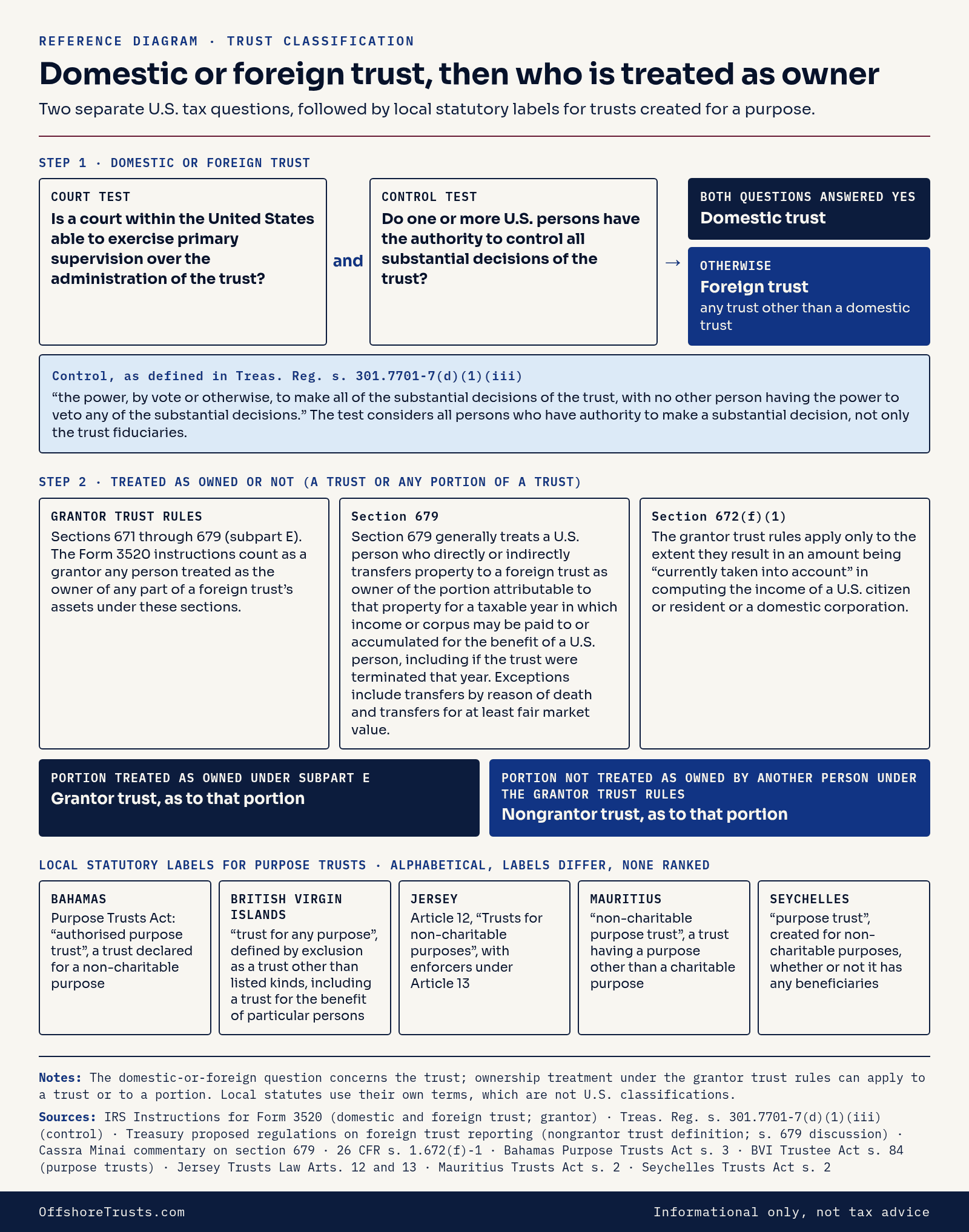
Data table for this infographic
| Group | Question or label | Description or rule | Result or source |
|---|---|---|---|
| Reference diagram · Trust classification | Domestic or foreign trust, then who is treated as owner | Two separate U.S. tax questions, followed by local statutory labels for trusts created for a purpose. | |
| Step 1 · Domestic or foreign trust | Court test | Is a court within the United States able to exercise primary supervision over the administration of the trust? | |
| Step 1 · Domestic or foreign trust | Control test | Do one or more U.S. persons have the authority to control all substantial decisions of the trust? | |
| Step 1 · Domestic or foreign trust | Both questions answered yes | Domestic trust | |
| Step 1 · Domestic or foreign trust | Otherwise | Foreign trust, any trust other than a domestic trust | |
| Control, as defined in Treas. Reg. s. 301.7701-7(d)(1)(iii) | Control | "the power, by vote or otherwise, to make all of the substantial decisions of the trust, with no other person having the power to veto any of the substantial decisions." The test considers all persons who have authority to make a substantial decision, not only the trust fiduciaries. | Treas. Reg. s. 301.7701-7(d)(1)(iii) |
| Step 2 · Treated as owned or not (a trust or any portion of a trust) | Grantor trust rules | Sections 671 through 679 (subpart E). The Form 3520 instructions count as a grantor any person treated as the owner of any part of a foreign trust's assets under these sections. | |
| Step 2 · Treated as owned or not (a trust or any portion of a trust) | Section 679 | Section 679 generally treats a U.S. person who directly or indirectly transfers property to a foreign trust as owner of the portion attributable to that property for a taxable year in which income or corpus may be paid to or accumulated for the benefit of a U.S. person, including if the trust were terminated that year. Exceptions include transfers by reason of death and transfers for at least fair market value. | |
| Step 2 · Treated as owned or not (a trust or any portion of a trust) | Section 672(f)(1) | The grantor trust rules apply only to the extent they result in an amount being "currently taken into account" in computing the income of a U.S. citizen or resident or a domestic corporation. | |
| Step 2 · Treated as owned or not (a trust or any portion of a trust) | Portion treated as owned under subpart E | Grantor trust, as to that portion | |
| Step 2 · Treated as owned or not (a trust or any portion of a trust) | Portion not treated as owned by another person under the grantor trust rules | Nongrantor trust, as to that portion | |
| Local statutory labels for purpose trusts · alphabetical, labels differ, none ranked | Bahamas | Purpose Trusts Act: "authorised purpose trust", a trust declared for a non-charitable purpose | statute |
| Local statutory labels for purpose trusts · alphabetical, labels differ, none ranked | British Virgin Islands | "trust for any purpose", defined by exclusion as a trust other than listed kinds, including a trust for the benefit of particular persons | statute |
| Local statutory labels for purpose trusts · alphabetical, labels differ, none ranked | Jersey | Article 12, "Trusts for non-charitable purposes", with enforcers under Article 13 | statute |
| Local statutory labels for purpose trusts · alphabetical, labels differ, none ranked | Mauritius | "non-charitable purpose trust", a trust having a purpose other than a charitable purpose | statute |
| Local statutory labels for purpose trusts · alphabetical, labels differ, none ranked | Seychelles | "purpose trust", created for non-charitable purposes, whether or not it has any beneficiaries | statute |
| Notes | Commentary and statute | The domestic-or-foreign question concerns the trust; ownership treatment under the grantor trust rules can apply to a trust or to a portion. Local statutes use their own terms, which are not U.S. classifications. | commentary |
| Sources | U.S. sources | IRS Instructions for Form 3520 (domestic and foreign trust; grantor) · Treas. Reg. s. 301.7701-7(d)(1)(iii) (control) · Treasury proposed regulations on foreign trust reporting (nongrantor trust definition; s. 679 discussion) · Cassra Minai commentary on section 679 · 26 CFR s. 1.672(f)-1 | |
| Sources | Local statute sources | Bahamas Purpose Trusts Act s. 3 · BVI Trustee Act s. 84 (purpose trusts) · Jersey Trusts Law Arts. 12 and 13 · Mauritius Trusts Act s. 2 · Seychelles Trusts Act s. 2 | |
Foreign trust (statutory usage)
The statutory meaning of foreign trust depends on the law using the term. The Trusts (Jersey) Law defines a foreign trust as a trust whose proper law is another jurisdiction's law. It defines a Jersey trust as one whose proper law is Jersey law, so the labels turn on governing law.[8]
Bermuda's Trusts (Special Provisions) Act defines the term by contrast with its local category. A trust governed wholly or partly by Bermuda law is a Bermuda trust, and any other trust is a foreign trust.[9] These definitions concern governing law, while U.S. federal tax classification depends on the court and control tests.[8][9]
The Jersey definition appears in the interpretation article of the Trusts (Jersey) Law. Part 3 applies only to a foreign trust, while Part 4 applies to a Jersey trust and, where context permits, to a foreign trust. Under Jersey law, a foreign trust's proper law governs its interpretation, subject to stated exceptions. Certain provisions are also excluded for a foreign trust whose proper law is that of a jurisdiction covered by the Convention.[8]
Bermuda's Act uses the label in provisions for foreign trusts meeting a local connection rule. The conditions are a trust instrument conferring jurisdiction on Bermuda courts and trust administration carried on in Bermuda.[9]
The Hague Trusts Convention defines trust, rather than foreign trust, as a legal relationship created during life or on death. Assets are placed under a trustee's control for a beneficiary or specified purpose, form a separate fund, and are held in title by or for the trustee. The trustee manages, uses, or disposes of the assets under the trust terms and legal duties. Reserved settlor powers and a trustee's own beneficiary rights are not necessarily inconsistent with a trust. The Convention applies only to trusts created voluntarily and evidenced in writing; it specifies applicable law and governs recognition.[10]
Questions and answers
How does the IRS distinguish a foreign trust from a domestic trust?
The regulations apply a court test and a control test. A trust is domestic only if it meets both, so failing either test means it is foreign for federal tax purposes.[3]
What U.S. forms are associated with a foreign trust?
The Form 3520 instructions identify reporting for transfers and ownership. They also address distributions. Form 3520-A is the annual information return for a foreign trust with a U.S. owner.[1][2]
Does every transfer to a foreign trust count as a reportable event?
Section 6048 defines reportable events to include creation of a foreign trust by a U.S. person and transfers of money or property by a U.S. person to a foreign trust. The Form 3520 instructions also describe specified exceptions from reporting.[1][6]
How does a foreign trust relate to U.S. ownership?
A U.S. person treated as owner of any portion under the grantor trust rules has information reporting responsibilities. Section 679 addresses certain transfers by U.S. persons to foreign trusts with U.S. beneficiaries.[5][6]
What is the difference between grantor and nongrantor trust?
A grantor trust is a trust, or portion of a trust, treated as owned by a person under sections 671 through 679, while a nongrantor trust is a trust, or portion, not treated as owned by another person under those rules. The foreign trust classification is determined under the court and control tests. Ownership treatment is addressed under the grantor trust rules.[1][3]
Related terms
- Foreign grantor trust: A foreign grantor trust is a foreign trust treated as owned by a grantor, often a U.S. person. Ownership brings Form 3520 and Form 3520-A reporting duties.
- Foreign trust classification: A trust is foreign under Form 3520 when it fails either domestic trust test. The tests ask about U.S. court supervision and control of substantial decisions.
- Domestic trust: The IRS defines a domestic trust through its court test and control test, and the term appears in U.S. foreign trust reporting rules for U.S. citizens.
- Court test: The IRS court test asks whether a U.S. court can supervise trust administration. It works with the control test to determine whether a trust is domestic.
Related guides and articles
- The court and control tests for foreign trusts: The court test and the control test classify a trust as domestic or foreign, and foreign trust status connects to U.S. reporting rules for U.S. citizens.
- Section 6048 reporting for certain foreign trusts: Section 6048 foreign trust reporting for U.S. citizens, including definitions and reportable events, as well as ownership and distributions and the IRS forms.
- Tax planning and compliance for foreign trusts: U.S. rules classify trusts and assign tax and reporting duties to U.S. citizens connected with foreign trusts, including forms, filing calendars and records.
Related pages
Sources and data notes
- Internal Revenue Service, Instructions for Form 3520. https://www.irs.gov/instructions/i3520. Retrieved .
- Internal Revenue Service, Instructions for Form 3520-A. https://www.irs.gov/instructions/i3520a. Retrieved .
- Internal Revenue Service, 26 CFR 301.7701-7 Trusts, domestic and foreign. https://ecfr.io/Title-26/Section-301.7701-7. Retrieved .
- Internal Revenue Service, 26 CFR 301.7701-4 Trusts. https://www.ecfr.gov/current/title-26/section-301.7701-4. Retrieved .
- Internal Revenue Service, 26 U.S.C. 679. https://uscode.house.gov/us/usc/119-118/t26/s679/. Retrieved .
- Internal Revenue Service, 26 U.S.C. 6048. https://uscode.house.gov/us/usc/119-118/t26/s6048/. Retrieved .
- Internal Revenue Service, Foreign trust reporting requirements and tax consequences. https://www.irs.gov/businesses/international-businesses/foreign-trust-reporting-requirements-and-tax-consequences. Retrieved .
- Jersey Legal Information Board, Trusts (Jersey) Law 1984. https://jerseylaw.je/laws/current/l_11_1984. Retrieved .
- Legislature of Bermuda, Trusts (Special Provisions) Act 1989. https://bermuda.fm/legislation/1591. Retrieved .
- HCCH, 1985 Hague Trusts Convention. https://www.hcch.net/en/instruments/conventions/full-text/?cid=59. Retrieved .
Dates in this block record when each source was read for this page.