
How the IRS classifies trusts for U.S. tax purposes
Trust classification runs from ordinary and investment trusts to U.S. person status and a specific reporting rule.
What a trust means for federal tax purposes
An ordinary trust is an arrangement in which trustees hold title to property and are responsible for conserving it for beneficiaries. The regulation describes arrangements established by will or by a declaration made during the creator's lifetime.[1]
Beneficiaries ordinarily receive the arrangement's benefits without having planned or created it. A beneficiary can nevertheless create a qualifying trust if its purpose is to conserve property. The beneficiary's relationship to the property must be the same as if someone else had established the trust.[1]
The Code uses person as a category that includes trusts alongside individuals and several kinds of organizations. It also includes a trustee within its definition of fiduciary.[2]
How the arrangement's purpose affects classification
Federal tax classification follows an arrangement's actual character, regardless of whether its legal documents call it a trust. Conveying property to trustees for named beneficiaries does not establish trust classification if the organization is properly classified as a business entity.[1]
Under the ordinary-trust rule, trustees are responsible for conserving property, and beneficiaries cannot participate in that responsibility. Business or commercial trusts generally arise when beneficiaries establish an arrangement to operate a business for profit. Such a business would normally use a corporation or partnership.[1]
The identity of the person contributing trust property does not by itself determine classification. Property contributed by someone other than the beneficiaries is insufficient on its own to establish ordinary-trust classification.[1]
How investment trusts are classified
An investment trust's classification depends on investment powers and the structure of ownership interests. A power in the agreement to change the certificate holders' investments prevents classification as a trust under this rule.[1]
- A single ownership class qualifies if it represents undivided beneficial interests in trust assets. The agreement must also contain no power to change the certificate holders' investments.[1]
- Multiple ownership classes ordinarily result in business-entity classification.[1]
- Multiple classes can qualify when investment-changing powers are absent and the trust facilitates direct investment in its assets. The classes must be incidental to that purpose.[1]
The regulation illustrates the distinction with stock deposited in exchange for two separately tradable certificates. Splitting dividend rights from part of the stock's appreciation creates interests materially different from direct stock ownership. The example classifies the arrangement as a business entity.[1]
When a liquidating arrangement qualifies
A liquidating trust qualifies when its primary purpose is to liquidate and distribute transferred assets and its activities are reasonably necessary for that purpose. Its trust classification rests on liquidating particular assets instead of operating an ongoing business for profit.[1]
An unreasonably prolonged liquidation can end that classification. The same applies when business activities obscure the liquidation purpose until that purpose has effectively been abandoned.[1]
How a trust qualifies as a U.S. person
A trust qualifies as a United States person under section 7701(a)(30)(E) when it satisfies both a supervision condition and a decision-control condition. A U.S. citizen also falls within the statute's United States person definition.[2]
- Supervision requires a court in the United States to be able to exercise primary supervision over the trust's administration.[2]
- Decision control requires one or more United States persons to have authority to control all substantial trust decisions.[2]
Section 7701(a)(31)(B) defines a foreign trust by reference to those conditions. A trust outside the category described in section 7701(a)(30)(E) falls within that foreign-trust definition.[2]
Where classification connects to reporting
The regulation gives a specific ownership and reporting rule for environmental remediation trusts. Qualification requires a state-law trust primarily collecting and disbursing funds for remediation of an existing waste site. It also requires qualifying contributor liability. The trust must be excluded from qualified settlement fund status.[1]
For this category, each contributor, called a grantor, is treated as owning the portion that contributor contributed. Income and deduction items appear on a separate statement attached to Form 1041, along with credit items. The trust does not report them on the form itself.[1]
The trustee must give each grantor a statement identifying the items attributable to that grantor's portion. The statement supplies information for computing taxable income and helps determine the items' federal tax treatment.[1]
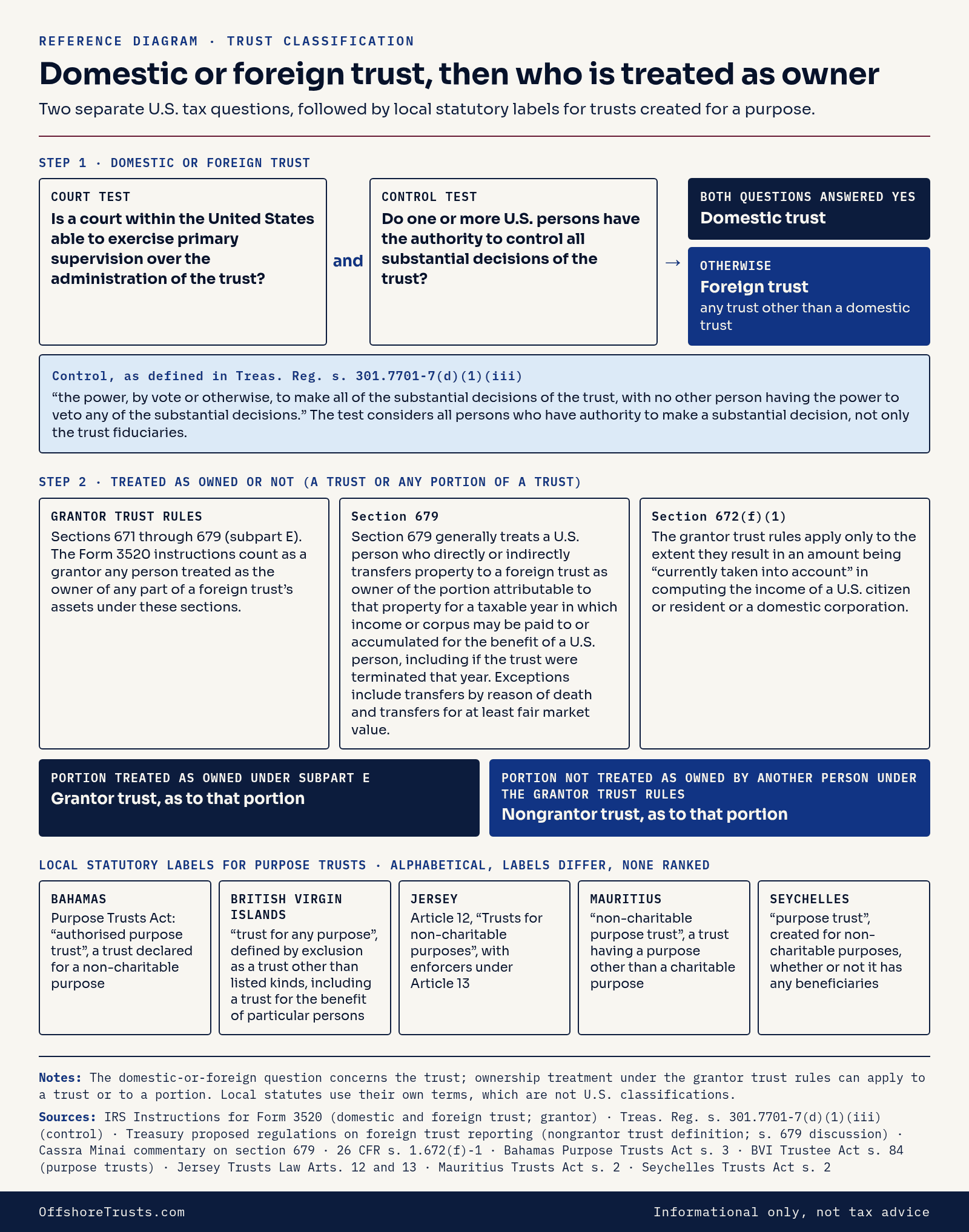
Data table for this infographic
| Group | Question or label | Description or rule | Result or source |
|---|---|---|---|
| Reference diagram · Trust classification | Domestic or foreign trust, then who is treated as owner | Two separate U.S. tax questions, followed by local statutory labels for trusts created for a purpose. | |
| Step 1 · Domestic or foreign trust | Court test | Is a court within the United States able to exercise primary supervision over the administration of the trust? | |
| Step 1 · Domestic or foreign trust | Control test | Do one or more U.S. persons have the authority to control all substantial decisions of the trust? | |
| Step 1 · Domestic or foreign trust | Both questions answered yes | Domestic trust | |
| Step 1 · Domestic or foreign trust | Otherwise | Foreign trust, any trust other than a domestic trust | |
| Control, as defined in Treas. Reg. s. 301.7701-7(d)(1)(iii) | Control | "the power, by vote or otherwise, to make all of the substantial decisions of the trust, with no other person having the power to veto any of the substantial decisions." The test considers all persons who have authority to make a substantial decision, not only the trust fiduciaries. | Treas. Reg. s. 301.7701-7(d)(1)(iii) |
| Step 2 · Treated as owned or not (a trust or any portion of a trust) | Grantor trust rules | Sections 671 through 679 (subpart E). The Form 3520 instructions count as a grantor any person treated as the owner of any part of a foreign trust's assets under these sections. | |
| Step 2 · Treated as owned or not (a trust or any portion of a trust) | Section 679 | Section 679 generally treats a U.S. person who directly or indirectly transfers property to a foreign trust as owner of the portion attributable to that property for a taxable year in which income or corpus may be paid to or accumulated for the benefit of a U.S. person, including if the trust were terminated that year. Exceptions include transfers by reason of death and transfers for at least fair market value. | |
| Step 2 · Treated as owned or not (a trust or any portion of a trust) | Section 672(f)(1) | The grantor trust rules apply only to the extent they result in an amount being "currently taken into account" in computing the income of a U.S. citizen or resident or a domestic corporation. | |
| Step 2 · Treated as owned or not (a trust or any portion of a trust) | Portion treated as owned under subpart E | Grantor trust, as to that portion | |
| Step 2 · Treated as owned or not (a trust or any portion of a trust) | Portion not treated as owned by another person under the grantor trust rules | Nongrantor trust, as to that portion | |
| Local statutory labels for purpose trusts · alphabetical, labels differ, none ranked | Bahamas | Purpose Trusts Act: "authorised purpose trust", a trust declared for a non-charitable purpose | statute |
| Local statutory labels for purpose trusts · alphabetical, labels differ, none ranked | British Virgin Islands | "trust for any purpose", defined by exclusion as a trust other than listed kinds, including a trust for the benefit of particular persons | statute |
| Local statutory labels for purpose trusts · alphabetical, labels differ, none ranked | Jersey | Article 12, "Trusts for non-charitable purposes", with enforcers under Article 13 | statute |
| Local statutory labels for purpose trusts · alphabetical, labels differ, none ranked | Mauritius | "non-charitable purpose trust", a trust having a purpose other than a charitable purpose | statute |
| Local statutory labels for purpose trusts · alphabetical, labels differ, none ranked | Seychelles | "purpose trust", created for non-charitable purposes, whether or not it has any beneficiaries | statute |
| Notes | Commentary and statute | The domestic-or-foreign question concerns the trust; ownership treatment under the grantor trust rules can apply to a trust or to a portion. Local statutes use their own terms, which are not U.S. classifications. | commentary |
| Sources | U.S. sources | IRS Instructions for Form 3520 (domestic and foreign trust; grantor) · Treas. Reg. s. 301.7701-7(d)(1)(iii) (control) · Treasury proposed regulations on foreign trust reporting (nongrantor trust definition; s. 679 discussion) · Cassra Minai commentary on section 679 · 26 CFR s. 1.672(f)-1 | |
| Sources | Local statute sources | Bahamas Purpose Trusts Act s. 3 · BVI Trustee Act s. 84 (purpose trusts) · Jersey Trusts Law Arts. 12 and 13 · Mauritius Trusts Act s. 2 · Seychelles Trusts Act s. 2 | |
Questions and answers
Does calling an arrangement a trust establish its federal tax classification?
The trust label alone does not settle its classification. The regulation preserves business-entity classification where that classification reflects the organization's actual character.[1]
Can a beneficiary create an ordinary trust?
A beneficiary can create an arrangement that qualifies as an ordinary trust. The stated conditions include conserving trust property and a beneficiary relationship equivalent to one under a trust established by someone else.[1]
Does my U.S. citizenship mean a trust qualifies as a United States person?
Citizenship places an individual within the United States person definition. A trust has separate conditions involving U.S. supervision of administration, and United States persons must have authority over all substantial decisions.[2]
Do multiple ownership classes always prevent investment-trust classification?
Multiple classes ordinarily produce business-entity classification, with an exception. Trust classification remains available when there is no investment-changing power and the arrangement facilitates direct investment. The multiple classes must be incidental to that purpose.[1]
Related resources
Related glossary terms
- Power to revoke: Section 676 defines a power to revest trust property in the grantor. When the power applies, the grantor is treated as owner of the covered trust portion.
- Unit trust: The Jersey Trusts Law defines a unit trust by its purpose or effect of giving investors participation as beneficiaries in profits or income from property.
- Tax residence: Tax residence describes a person's status in a country for tax purposes. Treaty texts address how it affects income items and applicable treaty requirements.
Related articles and guides
- 26 CFR § 301.7701-4, Trusts: 26 CFR § 301.7701-4 covers arrangements treated as trusts for U.S. federal tax purposes, including investment trusts and environmental remediation trusts.
- What a trust means under U.S. and international law: Trust terms and structure, the Hague Convention's rules, and U.S. tax classification and limited reporting rules, all explained plainly for U.S. citizens.
- Section 679 and foreign trusts with U.S. beneficiaries: Section 679 covers ownership treatment, U.S. beneficiaries, transfer exceptions and related reporting rules for foreign trusts connected to U.S. citizens.
Related pages
Sources and data notes
- U.S. Department of the Treasury; Office of the Federal Register, 26 CFR § 301.7701-4, Trusts. https://www.ecfr.gov/current/title-26/section-301.7701-4. Retrieved .
- United States Congress, Office of the Law Revision Counsel, 26 U.S.C. § 7701, Definitions. https://uscode.house.gov/us/usc/119-118/t26/s7701/. Retrieved .
Dates in this block record when each source was read for this page.