
Transfer to a foreign trust
The Form 3520 instructions describe a transfer to a foreign trust as a movement of money or property, directly or indirectly, from a U.S. person. The term connects Form 3520 reporting with separate rules for gratuitous transfers and U.S. ownership.
Meaning in the reporting rules
The Form 3520 instructions use the term for a U.S. person's direct or indirect transfer of money or property to a foreign trust. They define a foreign trust as a trust other than a domestic trust, with domestic status depending on U.S. court supervision and U.S. persons' control of substantial decisions.[1][6]
The instructions place transfers in Part I of Form 3520 and discuss a related category called a gratuitous transfer. That category generally covers a transfer beyond fair market value, subject to specified exceptions. The instructions state that a transfer can count as gratuitous without being a gift for gift tax purposes.[1]
Reporting and related terms
Section 6048 treats a direct or indirect transfer by a U.S. person as a reportable event, including a transfer by reason of death. The transferor is generally the responsible party for a transfer other than one made because of death. The law excludes certain transfers for full fair market value, and it also excludes certain deferred compensation and charitable trusts.[6]
A fair market value exchange is not automatically outside Form 3520 reporting. The instructions list some fair market value transfers that remain reportable, including certain exchanges for obligations and transfers involving a related trust. U.S. persons generally report transfers to a foreign trust on Form 3520, subject to exceptions.[1]
The instructions distinguish transferor from grantor and owner. A grantor includes a person who creates a trust or makes a gratuitous transfer, while a U.S. person may be treated as owner of the portion tied to transferred property when a U.S. beneficiary exists. The statute excepts transfers by reason of death and transfers for at least fair market value from that ownership rule.[1][5]
The instructions also identify adjacent reporting. A U.S. person transferring money or property may have a Form 709 filing requirement, while Form 1040 Schedule B Part III is identified for a person who was a grantor or transferor to a foreign trust.[7]
Conditions that change the treatment
The gratuitous transfer definition excludes transfers for fair market value and certain payments to a trust tied to its investment interest in another entity or specified investment, liquidating, or environmental remediation trusts. The instructions say that an interest received in the trust itself is disregarded when deciding whether fair market value was received.[1]
For a related foreign trust, an exchange for the trust's obligation or a related person's obligation is generally gratuitous unless the obligation qualifies under the instructions' qualified obligation rules. Section 679 separately ties ownership treatment to a U.S. beneficiary, while recognizing the stated exceptions for death and full-value transfers.[1][5]
Section 679 also addresses a person who transferred property before becoming a U.S. resident, and a trust that later becomes foreign. In the described circumstances, the rules treat a specified amount as transferred on the residency starting date or when the trust becomes foreign.[5]
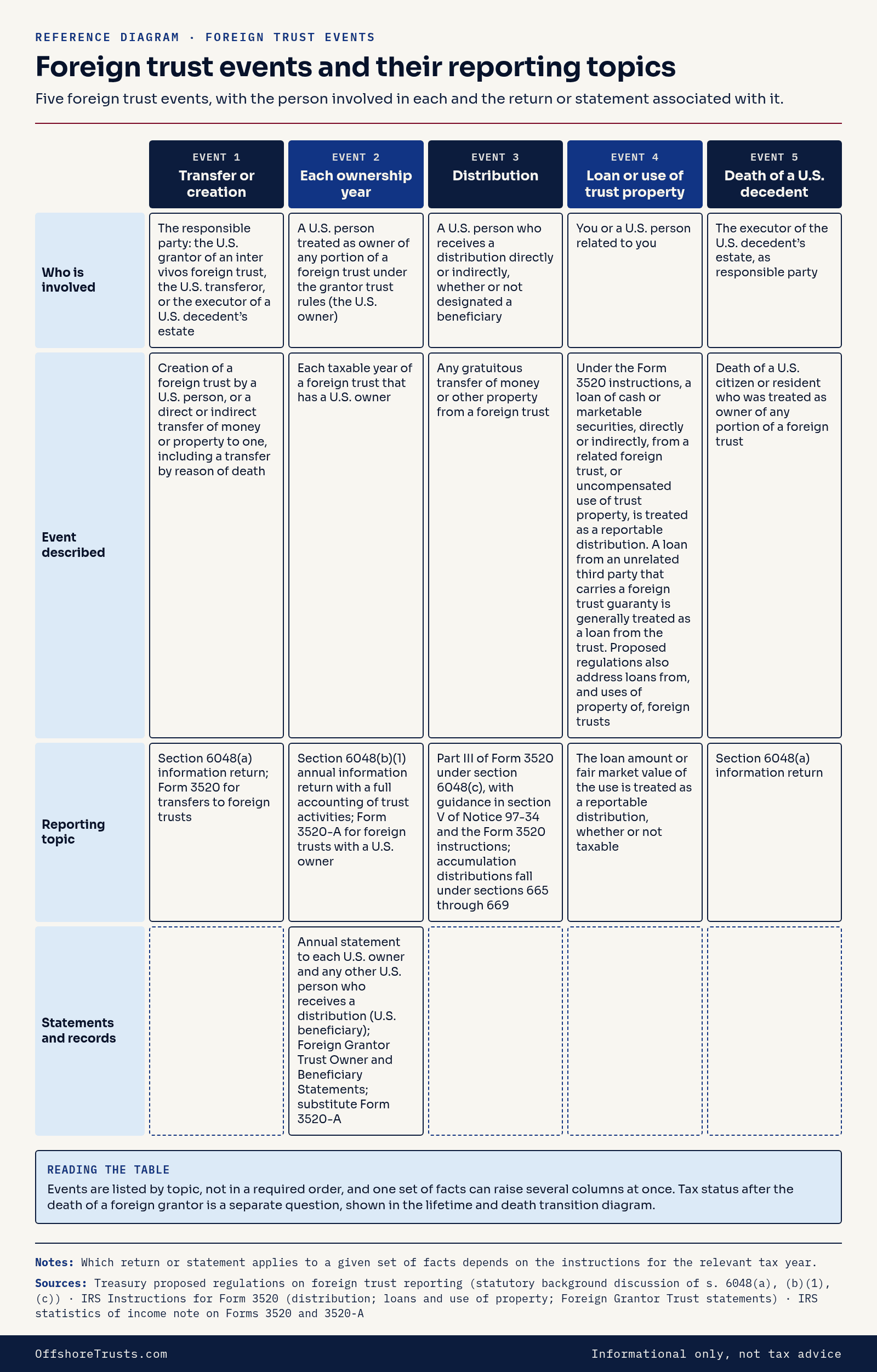
Data table for this infographic
| Event group | Event described | Who is involved | Reporting topic | Statements and records |
|---|---|---|---|---|
| Transfer or creation | Creation of a foreign trust by a U.S. person, or a direct or indirect transfer of money or property to one, including a transfer by reason of death | The responsible party: the U.S. grantor of an inter vivos foreign trust, the U.S. transferor, or the executor of a U.S. decedent's estate | Section 6048(a) information return; Form 3520 for transfers to foreign trusts | Not covered |
| Each ownership year | Each taxable year of a foreign trust that has a U.S. owner | A U.S. person treated as owner of any portion of a foreign trust under the grantor trust rules (the U.S. owner) | Section 6048(b)(1) annual information return with a full accounting of trust activities; Form 3520-A for foreign trusts with a U.S. owner | Annual statement to each U.S. owner and any other U.S. person who receives a distribution (U.S. beneficiary); Foreign Grantor Trust Owner and Beneficiary Statements; substitute Form 3520-A |
| Distribution | Any gratuitous transfer of money or other property from a foreign trust | A U.S. person who receives a distribution directly or indirectly, whether or not designated a beneficiary | Part III of Form 3520 under section 6048(c), with guidance in section V of Notice 97-34 and the Form 3520 instructions; accumulation distributions fall under sections 665 through 669 | Not covered |
| Loan or use of trust property | Under the Form 3520 instructions, a loan of cash or marketable securities, directly or indirectly, from a related foreign trust, or uncompensated use of trust property, is treated as a reportable distribution. A loan from an unrelated third party that carries a foreign trust guaranty is generally treated as a loan from the trust. Proposed regulations also address loans from, and uses of property of, foreign trusts. | You or a U.S. person related to you | The loan amount or fair market value of the use is treated as a reportable distribution, whether or not taxable | Not covered |
| Death of a U.S. decedent | Death of a U.S. citizen or resident who was treated as owner of any portion of a foreign trust | The executor of the U.S. decedent's estate, as responsible party | Section 6048(a) information return | Not covered |
Questions and answers
Does every transfer to a foreign trust count as a gratuitous transfer?
No. The Form 3520 instructions exclude transfers for fair market value and specified distributions to a trust tied to interests it holds. Some fair market value transfers still have to be reported under Form 3520 instructions.[1]
Does a transfer have to be a gift for gift tax purposes?
No. The instructions explain that a transfer may be treated as gratuitous for foreign trust reporting even if it is not a gift for gift tax purposes. The definitions are used for distinct purposes.[1]
What form reports a transfer to a foreign trust?
The instructions place transfers by U.S. persons in Part I of Form 3520. Section 6048 also describes a notice obligation for reportable events and names the transferor as responsible party for transfers other than those made by reason of death.[1][6]
When can a transfer affect whether the transferor is treated as an owner?
Section 679 provides that a U.S. person is treated as owner of the portion attributable to transferred property when a U.S. beneficiary exists for the relevant taxable year. The statute excludes transfers by reason of death and qualifying full-value transfers from this rule.[5]
Can an exchange for an obligation still be a transfer?
Yes. The Form 3520 instructions say an exchange for an obligation of a related foreign trust is generally a gratuitous transfer unless the obligation is qualified. They also state that transfers in exchange for obligations are reportable under section 6048(a).[1]
Related terms
- Grantor: Form 3520 describes a grantor as a person who creates a trust, transfers property to it without full value, or is treated as an owner under specified rules.
- Section 6048: Section 6048 sets information reporting rules for certain foreign trusts. Its parts cover notice of events, U.S. owner duties and beneficiary distributions.
- Responsible party: The Instructions for Form 3520 define the responsible party for specified events involving a foreign trust. The role differs from an owner or U.S. agent.
Related guides and articles
- Section 6048 reporting for certain foreign trusts: Section 6048 foreign trust reporting for U.S. citizens, including definitions and reportable events, as well as ownership and distributions and the IRS forms.
- Section 679 and foreign trusts with U.S. beneficiaries: Section 679 covers ownership treatment, U.S. beneficiaries, transfer exceptions and related reporting rules for foreign trusts connected to U.S. citizens.
- Foreign trust loans and use of property: For a U.S. citizen, IRS instructions treat certain loans from a related foreign trust and uncompensated use of trust property as reportable distributions.
Related pages
Sources and data notes
- Internal Revenue Service, Instructions for Form 3520. https://www.irs.gov/instructions/i3520. Retrieved .
- Internal Revenue Service, Instructions for Form 3520-A. https://www.irs.gov/instructions/i3520a. Retrieved .
- Internal Revenue Service, 26 CFR 301.7701-7 Trusts, domestic and foreign. https://ecfr.io/Title-26/Section-301.7701-7. Retrieved .
- Internal Revenue Service, 26 CFR 301.7701-4 Trusts. https://www.ecfr.gov/current/title-26/section-301.7701-4. Retrieved .
- Internal Revenue Service, 26 U.S.C. 679. https://uscode.house.gov/us/usc/119-118/t26/s679/. Retrieved .
- Internal Revenue Service, 26 U.S.C. 6048. https://uscode.house.gov/us/usc/119-118/t26/s6048/. Retrieved .
- Internal Revenue Service, Foreign trust reporting requirements and tax consequences. https://www.irs.gov/businesses/international-businesses/foreign-trust-reporting-requirements-and-tax-consequences. Retrieved .
Dates in this block record when each source was read for this page.