
U.S. owner of a foreign trust
The Form 3520 instructions define a U.S. owner by whether a person is treated as owning trust assets under grantor trust rules. For a U.S. citizen, that status connects the trust's income treatment with information reporting on Forms 3520 and 3520-A.
Meaning of the term
The Instructions for Form 3520 define an owner of a foreign trust as a person treated as owning any trust assets under sections 671 through 679. Ownership can apply to part of a trust, so the term does not necessarily mean the person owns every trust asset.[1]
The instructions distinguish this role from a grantor, which can include someone who creates a trust or transfers property to it. A grantor can also be treated as an owner, but the terms describe different ways a person may relate to the trust.[1]
Conditions and related terms
Section 679 addresses a U.S. person's transfer of property to a foreign trust when a U.S. beneficiary exists for any portion of it. The statute treats the person as owner of the portion attributable to that property for the taxable year in question, subject to its stated exception for certain trusts.[5]
The Form 3520 instructions say a foreign trust is generally treated as having a U.S. beneficiary after a U.S. person transfers property, unless the trust instrument specifically bars distributions to U.S. persons at any time and cannot be amended to allow them. A contingent interest can count even if the person receives no distribution during the year.[1]
The instructions also describe circumstances involving trust loans or use of trust property. If a foreign trust with a U.S. transferor makes a loan or permits use without the specified repayment or fair market value payment within a reasonable period, the trust may be treated as having a U.S. beneficiary and as a grantor trust.[1]
The term U.S. beneficiary has a different focus from ownership under the grantor trust rules. It generally includes a U.S. person who could possibly benefit from the trust, whether or not named in its instrument or able to receive a distribution in the current year.[1]
Forms and reporting context
The Instructions for Form 3520 say a U.S. person treated as owner of any part of a foreign trust completes Part II. The instructions also identify a person treated as owner under sections 671 through 679 as a Form 3520 filer for the applicable reporting category.[1]
Form 3520-A is the annual information return for a foreign trust with at least one U.S. owner. Form 3520-A is filed by the foreign trust and includes annual statements for U.S. owners and beneficiaries.[2]
If the trust does not file Form 3520-A, the owner files a substitute with the owner's Form 3520. The IRS overview also explains that, in general, a U.S. person treated as owner under the grantor trust rules is taxed on income attributable to the portion treated as owned, with the Foreign Grantor Trust Owner Statement supplying income information.[7]
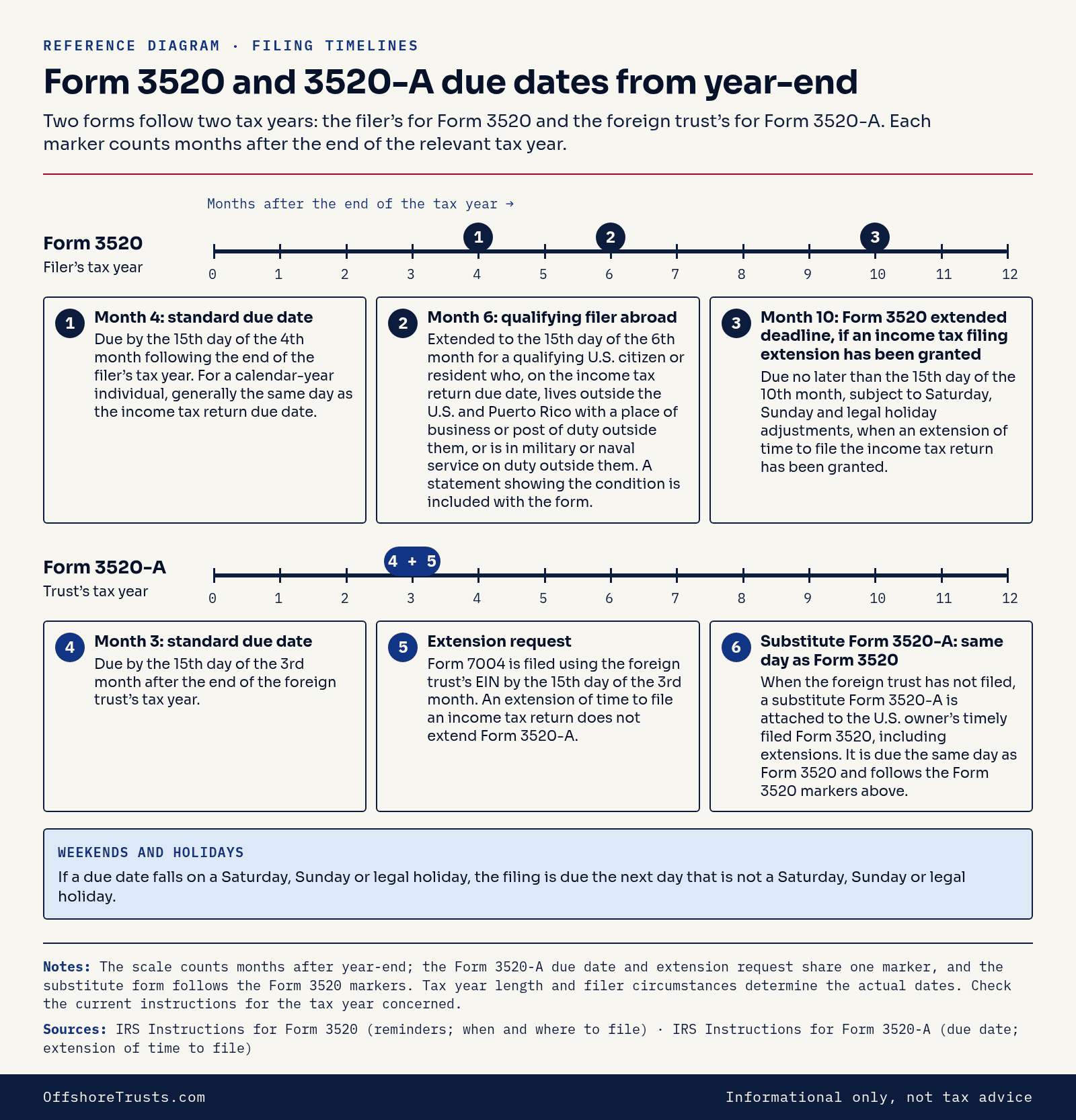
Data table for this infographic
| Form | Tax year used | Due date or condition | Description |
|---|---|---|---|
| Form 3520 | The filer's own tax year | Month 4: standard due date | Due by the 15th day of the 4th month following the end of the filer's tax year. For a calendar-year individual, generally the same day as the income tax return due date. |
| Form 3520 | The filer's own tax year | Month 6: qualifying filer abroad | Extended to the 15th day of the 6th month for a qualifying U.S. citizen or resident who, on the income tax return due date, lives outside the U.S. and Puerto Rico with a place of business or post of duty outside them, or is in military or naval service on duty outside them. A statement showing the condition is included with the form. |
| Form 3520 | The filer's own tax year | Month 10: Form 3520 extended deadline, if an income tax filing extension has been granted | Due no later than the 15th day of the 10th month, subject to Saturday, Sunday and legal holiday adjustments, when an extension of time to file the income tax return has been granted. |
| Form 3520-A | The foreign trust's tax year | Month 3: standard due date | Due by the 15th day of the 3rd month after the end of the foreign trust's tax year. |
| Form 3520-A | The foreign trust's tax year | Extension request | Form 7004 is filed using the foreign trust's EIN by the 15th day of the 3rd month. An extension of time to file an income tax return does not extend Form 3520-A. |
| Substitute Form 3520-A | Follows the filer's Form 3520 timeline | Same day as Form 3520 | When the foreign trust has not filed, a substitute Form 3520-A is attached to the U.S. owner's timely filed Form 3520, including extensions. It is due the same day as Form 3520 and follows the Form 3520 markers above. |
| All forms | The tax year used for each form | Weekends and holidays | If a due date falls on a Saturday, Sunday or legal holiday, the filing is due the next day that is not a Saturday, Sunday or legal holiday. |
| Notes | The filer's or the foreign trust's tax year, as applicable | Scope | The scale counts months after year-end; the Form 3520-A due date and extension request share one marker, and the substitute form follows the Form 3520 markers. Tax year length and filer circumstances determine the actual dates. The instructions for the tax year concerned govern. |
| Sources | Form 3520: the filer's own tax year. Form 3520-A: the foreign trust's tax year | Documents | IRS Instructions for Form 3520 (reminders; when and where to file) · IRS Instructions for Form 3520-A (due date; extension of time to file) |
Questions and answers
Does a U.S. owner have to own the whole foreign trust?
No. The Form 3520 instructions define ownership by reference to any assets of the trust, and Part II applies when a person is considered owner of any assets.[1]
How can a transferor become a U.S. owner under section 679?
Section 679 applies when a U.S. person directly or indirectly transfers property to a foreign trust and a U.S. beneficiary exists for any portion. The person is treated as owner of the portion attributable to the property for that taxable year, subject to the statutory exception.[5]
How is a U.S. owner different from a U.S. beneficiary?
Owner refers to a person treated as owning trust assets under grantor trust rules. Beneficiary generally refers to a U.S. person who could possibly benefit from the trust, whether or not designated in the trust instrument.[1]
Which forms are associated with U.S. owner status?
The Form 3520 instructions direct a U.S. person considered owner of foreign trust assets to complete Part II. Form 3520-A is the annual information return for a foreign trust with a U.S. owner, and a substitute may be attached to Form 3520 if the trust does not file it.[2]
Related terms
- U.S. beneficiary of a foreign trust: The Form 3520 instructions explain who is a U.S. beneficiary of a foreign trust and how that status relates to distributions and ownership, plus reporting.
- Section 679: Section 679 addresses certain transfers by U.S. persons to foreign trusts. It treats some property transfers as ownership when the trust has a U.S. beneficiary.
- Grantor: Form 3520 describes a grantor as a person who creates a trust, transfers property to it without full value, or is treated as an owner under specified rules.
- Nongrantor trust: A nongrantor trust is taxable to the extent its assets are not treated as owned by another person. Partial treatment and beneficiary reporting both apply.
Related guides and articles
- Section 679 and foreign trusts with U.S. beneficiaries: Section 679 covers ownership treatment, U.S. beneficiaries, transfer exceptions and related reporting rules for foreign trusts connected to U.S. citizens.
- Grantor and nongrantor trust taxation: U.S. income tax rules distinguish grantor and nongrantor trusts for U.S. citizens. Sections 671 through 679 may assign ownership of all or part of a trust.
- Section 679 and U.S. Transfers to Foreign Trusts: Section 679 may treat a U.S. transferor as owner of the foreign trust portion tied to transferred property when a U.S. beneficiary may benefit from the trust.
Related pages
Sources and data notes
- Internal Revenue Service, Instructions for Form 3520. https://www.irs.gov/instructions/i3520. Retrieved .
- Internal Revenue Service, Instructions for Form 3520-A. https://www.irs.gov/instructions/i3520a. Retrieved .
- Internal Revenue Service, 26 CFR 301.7701-7 Trusts, domestic and foreign. https://ecfr.io/Title-26/Section-301.7701-7. Retrieved .
- Internal Revenue Service, 26 CFR 301.7701-4 Trusts. https://www.ecfr.gov/current/title-26/section-301.7701-4. Retrieved .
- Internal Revenue Service, 26 U.S.C. 679. https://uscode.house.gov/us/usc/119-118/t26/s679/. Retrieved .
- Internal Revenue Service, 26 U.S.C. 6048. https://uscode.house.gov/us/usc/119-118/t26/s6048/. Retrieved .
- Internal Revenue Service, Foreign trust reporting requirements and tax consequences. https://www.irs.gov/businesses/international-businesses/foreign-trust-reporting-requirements-and-tax-consequences. Retrieved .
Dates in this block record when each source was read for this page.