
26 C.F.R. § 301.7701-7, Trusts
26 C.F.R. § 301.7701-7 defines domestic and foreign trusts and sets out tests for classifying them under the Internal Revenue Code.
Document and scope
26 C.F.R. § 301.7701-7 is a federal regulation titled "Trusts, domestic and foreign." Its provisions address how a trust is classified as domestic or foreign, how the court and control tests work, and certain rules for trust income and elections.[1]
The regulation treats a trust as a United States person on any day it meets both tests. A domestic trust is a trust that is a United States person under this section; a foreign trust is any trust other than a domestic trust.[1]
The two classification tests
The court test asks whether a U.S. court can exercise primary supervision over trust administration. The regulation defines the United States geographically for this test as the States and the District of Columbia. A court in a territory, possession, or foreign country does not count as a court within the United States for this purpose.[1]
A safe harbor applies when the trust instrument does not direct administration outside the United States, the trust is administered exclusively in the United States, and no specified automatic migration provision applies. The regulation also lists situations that can satisfy or fail the court test; its listed situations are not exhaustive.[1]
The control test asks whether one or more U.S. persons have authority over all substantial decisions. Substantial decisions are authorized or required under the trust instrument and applicable law, and are not merely ministerial. Examples include decisions on distributions, beneficiaries, terminating the trust, changing trustees, and investments. Control means power to make all substantial decisions without another person's veto, and the analysis includes everyone with authority to decide, not only fiduciaries.[1]
The regulation says the trust instrument and applicable law govern both tests.
U.S. tax and reporting context
The regulation also states a general rule for computing a foreign trust's taxable income. Except where another provision in the applicable part of the Code applies, the income is computed in the same manner as that of a nonresident alien individual not present in the United States. The regulation separately says section 7701(b), which applies to individuals, does not apply to trusts.[1]
The classification of a trust and the individual's own reporting obligations are distinct questions.
Official text and related provisions
The regulation itself refers readers to Internal Revenue Code sections 6048 and 6677 for federal tax and reporting rules connected to a change in trust residence. It also contains an election provision for certain trusts to remain treated as domestic trusts, with eligibility conditions set out in the text.[1]
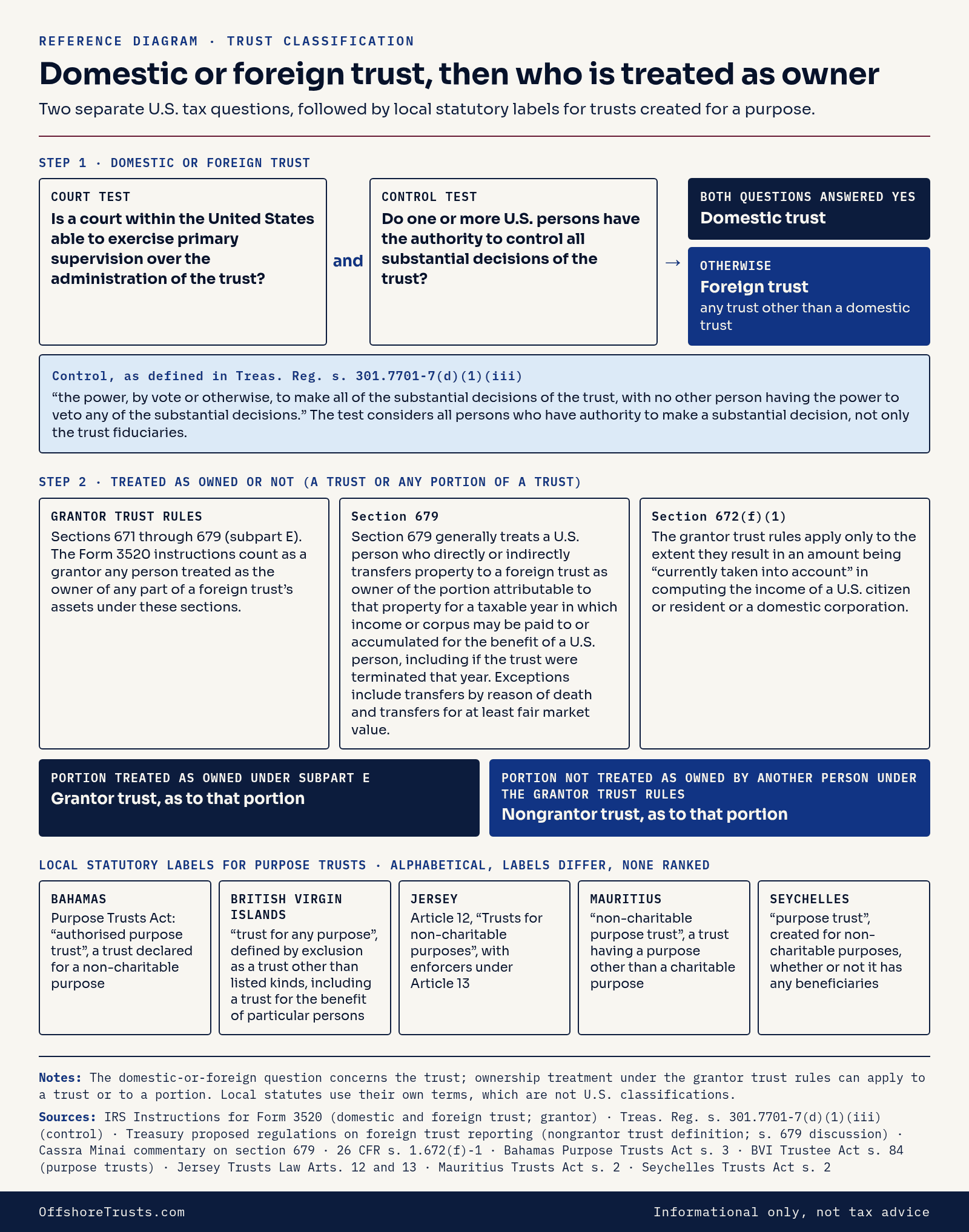
Data table for this infographic
| Group | Question or label | Description or rule | Result or source |
|---|---|---|---|
| Reference diagram · Trust classification | Domestic or foreign trust, then who is treated as owner | Two separate U.S. tax questions, followed by local statutory labels for trusts created for a purpose. | |
| Step 1 · Domestic or foreign trust | Court test | Is a court within the United States able to exercise primary supervision over the administration of the trust? | |
| Step 1 · Domestic or foreign trust | Control test | Do one or more U.S. persons have the authority to control all substantial decisions of the trust? | |
| Step 1 · Domestic or foreign trust | Both questions answered yes | Domestic trust | |
| Step 1 · Domestic or foreign trust | Otherwise | Foreign trust, any trust other than a domestic trust | |
| Control, as defined in Treas. Reg. s. 301.7701-7(d)(1)(iii) | Control | "the power, by vote or otherwise, to make all of the substantial decisions of the trust, with no other person having the power to veto any of the substantial decisions." The test considers all persons who have authority to make a substantial decision, not only the trust fiduciaries. | Treas. Reg. s. 301.7701-7(d)(1)(iii) |
| Step 2 · Treated as owned or not (a trust or any portion of a trust) | Grantor trust rules | Sections 671 through 679 (subpart E). The Form 3520 instructions count as a grantor any person treated as the owner of any part of a foreign trust's assets under these sections. | |
| Step 2 · Treated as owned or not (a trust or any portion of a trust) | Section 679 | Section 679 generally treats a U.S. person who directly or indirectly transfers property to a foreign trust as owner of the portion attributable to that property for a taxable year in which income or corpus may be paid to or accumulated for the benefit of a U.S. person, including if the trust were terminated that year. Exceptions include transfers by reason of death and transfers for at least fair market value. | |
| Step 2 · Treated as owned or not (a trust or any portion of a trust) | Section 672(f)(1) | The grantor trust rules apply only to the extent they result in an amount being "currently taken into account" in computing the income of a U.S. citizen or resident or a domestic corporation. | |
| Step 2 · Treated as owned or not (a trust or any portion of a trust) | Portion treated as owned under subpart E | Grantor trust, as to that portion | |
| Step 2 · Treated as owned or not (a trust or any portion of a trust) | Portion not treated as owned by another person under the grantor trust rules | Nongrantor trust, as to that portion | |
| Local statutory labels for purpose trusts · alphabetical, labels differ, none ranked | Bahamas | Purpose Trusts Act: "authorised purpose trust", a trust declared for a non-charitable purpose | statute |
| Local statutory labels for purpose trusts · alphabetical, labels differ, none ranked | British Virgin Islands | "trust for any purpose", defined by exclusion as a trust other than listed kinds, including a trust for the benefit of particular persons | statute |
| Local statutory labels for purpose trusts · alphabetical, labels differ, none ranked | Jersey | Article 12, "Trusts for non-charitable purposes", with enforcers under Article 13 | statute |
| Local statutory labels for purpose trusts · alphabetical, labels differ, none ranked | Mauritius | "non-charitable purpose trust", a trust having a purpose other than a charitable purpose | statute |
| Local statutory labels for purpose trusts · alphabetical, labels differ, none ranked | Seychelles | "purpose trust", created for non-charitable purposes, whether or not it has any beneficiaries | statute |
| Notes | Commentary and statute | The domestic-or-foreign question concerns the trust; ownership treatment under the grantor trust rules can apply to a trust or to a portion. Local statutes use their own terms, which are not U.S. classifications. | commentary |
| Sources | U.S. sources | IRS Instructions for Form 3520 (domestic and foreign trust; grantor) · Treas. Reg. s. 301.7701-7(d)(1)(iii) (control) · Treasury proposed regulations on foreign trust reporting (nongrantor trust definition; s. 679 discussion) · Cassra Minai commentary on section 679 · 26 CFR s. 1.672(f)-1 | |
| Sources | Local statute sources | Bahamas Purpose Trusts Act s. 3 · BVI Trustee Act s. 84 (purpose trusts) · Jersey Trusts Law Arts. 12 and 13 · Mauritius Trusts Act s. 2 · Seychelles Trusts Act s. 2 | |
Questions and answers
What makes a trust domestic under this regulation?
A trust is domestic under this section when it is a U.S. person. It is a U.S. person on a day when it meets both the court test and the control test.[1]
What does the court test measure?
It measures whether a court within the United States can exercise primary supervision over trust administration. For this test, the regulation defines the United States as the States and the District of Columbia.[1]
What decisions count as substantial decisions?
The term covers decisions authorized or required by the trust instrument and applicable law that are not ministerial. Examples include deciding distributions, selecting beneficiaries, and investment decisions.[1]
Does this regulation list forms for foreign accounts?
No. The regulation gives trust classification rules and refers to reporting requirements connected to a change in trust residence. It does not list forms for foreign accounts.[1]
Where does the regulation point for reporting rules on a change in trust residence?
It refers to Internal Revenue Code sections 6048 and 6677 for federal tax consequences and reporting requirements related to a change in trust residence.[1]
Related resources
Related glossary terms
- Control test: The control test is part of the IRS rules for classifying trusts as domestic or foreign. It describes whose authority over substantial decisions counts.
- Section 679: Section 679 addresses certain transfers by U.S. persons to foreign trusts. It treats some property transfers as ownership when the trust has a U.S. beneficiary.
- Nonadverse party: The Internal Revenue Code defines a nonadverse party by reference to the term adverse party. Sections 672 through 678 use the distinction in trust rules.
Related articles and guides
- 26 U.S.C. § 7701, Definitions: 26 U.S.C. § 7701 defines terms used across the Internal Revenue Code, including United States person and foreign trust, with context for U.S. citizen reporting.
- Rev. Rul. 2008-40, Foreign Trust Transfers: Rev. Rul. 2008-40 is an IRS ruling on transfers from certain qualified retirement plans to foreign trusts and Puerto Rico plans, and income inclusion.
- Rev. Proc. 2020-17 and foreign trust reporting: Rev. Proc. 2020-17 exempts certain tax-favored foreign trusts from the information reporting requirements of section 6048.
Related pages
Sources and data notes
- U.S. Government, Trusts, domestic and foreign. https://ecfr.io/Title-26/Section-301.7701-7. Retrieved .
Dates in this block record when each source was read for this page.