
26 U.S.C. § 672, Definitions and rules
26 U.S.C. § 672 defines terms and rules used in a subpart of the Internal Revenue Code concerning trusts. For a U.S. citizen, it explains how certain interests and powers are treated under that subpart, including in specified foreign trust situations.
Document and scope
Section 672 is a provision of Title 26, the Internal Revenue Code, published online by the Office of the Law Revision Counsel of the United States House of Representatives. It appears in Chapter 1 and sets definitions and rules for the subpart in which it is located. Its text covers adverse and nonadverse parties, related or subordinate parties, powers subject to prior notice or delay, spouse-held interests, and limits and special rules for applying the subpart.[1]
The provision supplies interpretive rules for that subpart. It does not itself set out a complete set of U.S. information return instructions for foreign trusts or foreign accounts, so its subject is trust ownership and attribution rules within the Code.[1]
Key definitions and attribution rules
An adverse party is defined by a substantial beneficial interest that would be affected adversely by exercising or not exercising a power over the trust. A holder of a general power of appointment over trust property is treated as having a beneficial interest. A nonadverse party is simply a person who does not meet the adverse-party definition.[1]
A related or subordinate party must be nonadverse and fall within specified relationships or roles. These include a spouse living with the grantor, certain close family members, and certain employees or corporate employees described in the statute. For the purposes of subsection (f) and sections 674 and 675, the statute presumes such a party is subservient to the grantor unless evidence establishes otherwise under the stated standard.[1]
A power can count under the subpart even if notice must come first or its effect begins only after a specified waiting period. The grantor is also treated as holding certain powers or interests held by a person who was the grantor's spouse when the power or interest arose. For a person who marries the grantor later, this treatment applies only to periods after the marriage; legal separation under the specified decree means the person is not considered married for the relevant rule.[1]
Foreign trust connection and U.S. reporting context
Section 672(f) generally limits the subpart's application to amounts taken into account in computing income under the Code for a U.S. citizen or resident, or a domestic corporation. The statute then states exceptions and special rules, including rules for certain revocable or irrevocable trust portions and compensation trusts. These provisions address how ownership and income treatment may operate in defined circumstances involving foreign persons and trusts.[1]
One special rule applies where a foreign person would otherwise be treated as owner of a trust portion and the trust has a U.S. person beneficiary. If that beneficiary transferred property to the foreign person, the beneficiary is treated as grantor of that portion to the extent of those transfers, subject to the statutory terms and exception for certain gifts. This can matter to a U.S. citizen connected to a foreign trust because it defines whose role as grantor is recognized under this subpart.[1]
Official text
The official online text is available through the United States Code Online at the Office of the Law Revision Counsel website. Section 672 sits in Title 26 of the Internal Revenue Code.[1]
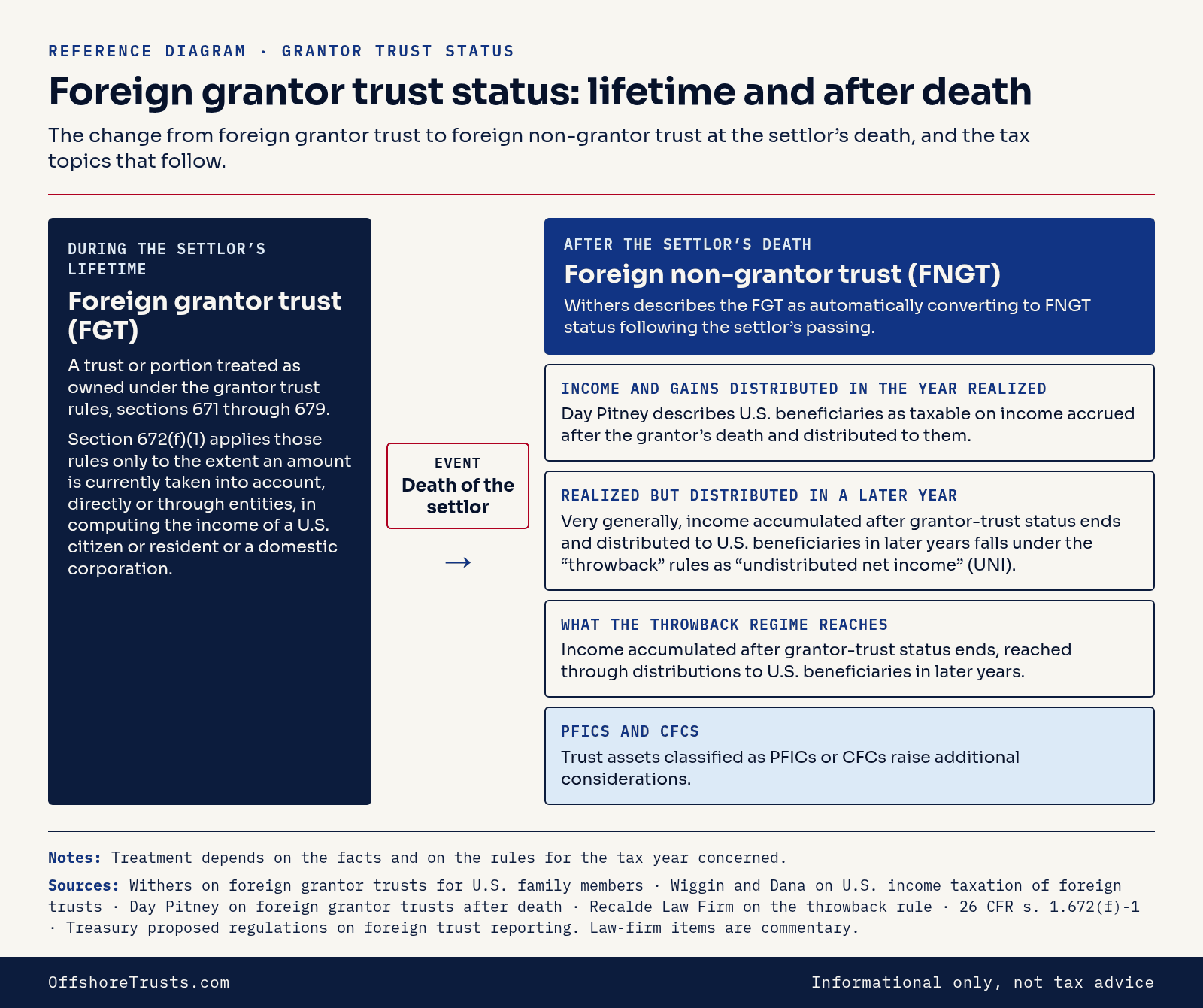
Data table for this infographic
| Stage or topic | Status or event | Description | Tax treatment or reporting |
|---|---|---|---|
| During the settlor's lifetime | Foreign grantor trust (FGT) | A trust or portion treated as owned under the grantor trust rules, sections 671 through 679. | Section 672(f)(1) applies those rules only to the extent an amount is currently taken into account, directly or through entities, in computing the income of a U.S. citizen or resident or a domestic corporation. |
| Event | Death of the settlor | Grantor trust status generally ends at the settlor's death. | |
| After the settlor's death | Foreign non-grantor trust (FNGT) | A foreign grantor trust generally converts automatically to foreign non-grantor trust status after the settlor's death. | |
| What the throwback regime reaches | Income accumulated after grantor-trust status ends, reached through distributions to U.S. beneficiaries in later years. | ||
| Notes | Treatment depends on the facts and on the rules for the tax year concerned. | ||
| Sources | Regulations and law-firm commentary | Withers on foreign grantor trusts for U.S. family members · Wiggin and Dana on U.S. income taxation of foreign trusts · Day Pitney on foreign grantor trusts after death · Recalde Law Firm on the throwback rule · 26 CFR s. 1.672(f)-1 · Treasury proposed regulations on foreign trust reporting. | Law-firm items are commentary. |
Income and gains distributed in the year realized: U.S. beneficiaries are generally taxable on income accrued after the grantor's death and distributed to them.
Realized but distributed in a later year: Very generally, income accumulated after grantor-trust status ends and distributed to U.S. beneficiaries in later years falls under the "throwback" rules as "undistributed net income" (UNI).
PFICs and CFCs: Trust assets classified as PFICs or CFCs raise additional considerations.
Questions and answers
What does 26 U.S.C. § 672 cover?
It defines adverse, nonadverse, and related or subordinate parties for the relevant subpart. It also states rules about powers, spouse-held interests, and application of the subpart in certain trust circumstances.[1]
How does the section define an adverse party?
The definition centers on a substantial beneficial interest that would be adversely affected by exercising or not exercising a power over the trust. A person with a general power of appointment over trust property is deemed to have a beneficial interest.[1]
Does section 672 list foreign account reporting forms?
Section 672 does not specify foreign account forms or filing thresholds. It addresses trust definitions, powers, and ownership treatment within the Internal Revenue Code subpart.[1]
What special rule applies to a U.S. beneficiary of a foreign person's trust?
If a foreign person would otherwise be treated as owner of a trust portion and the trust has a U.S. person beneficiary, the beneficiary is treated as grantor to the extent the beneficiary transferred property to that foreign person. The statute includes conditions and an exception for certain gifts.[1]
Where can I read the official text?
The provision is published in the United States Code Online by the Office of the Law Revision Counsel.
Related resources
Related glossary terms
- Section 679: Section 679 addresses certain transfers by U.S. persons to foreign trusts. It treats some property transfers as ownership when the trust has a U.S. beneficiary.
- Administrative powers (grantor trust): Section 675 of the Internal Revenue Code describes administrative powers that can cause a grantor to be treated as owner of a trust portion, with limits.
- Section 6048: Section 6048 sets information reporting rules for certain foreign trusts. Its parts cover notice of events, U.S. owner duties and beneficiary distributions.
Related articles and guides
- 26 U.S.C. § 7701, Definitions: 26 U.S.C. § 7701 defines terms used across the Internal Revenue Code, including United States person and foreign trust, with context for U.S. citizen reporting.
- Rev. Rul. 2008-40, Foreign Trust Transfers: Rev. Rul. 2008-40 is an IRS ruling on transfers from certain qualified retirement plans to foreign trusts and Puerto Rico plans, and income inclusion.
- Rev. Proc. 2020-17 and foreign trust reporting: Rev. Proc. 2020-17 covers its scope, trust definitions and eligibility conditions, and its link to U.S. reporting for certain foreign trusts and U.S. persons.
Related pages
Sources and data notes
- United States Congress, Office of the Law Revision Counsel, 26 U.S.C. § 672, Definitions and rules. https://uscode.house.gov/us/usc/119-118/t26/s672/. Retrieved .
Dates in this block record when each source was read for this page.