
Foreign trust forms and the accounts behind them
Forms 3520 and 3520-A connect to foreign trust transfers, ownership and distributions. The IRS instructions also describe how payments from trust accounts can count as distributions.
How section 6048 connects the forms
Section 6048 information reporting applies to certain U.S. persons who transfer property to a foreign trust, are treated as owners, or receive distributions. The IRS describes Forms 3520 and 3520-A as reporting forms under section 6048, with separate roles for the U.S. person and the trust.[3]
Form 3520 reports certain U.S. person transactions and distributions. Form 3520-A is the foreign trust's annual information return when it has at least one U.S. owner. It provides information about the trust, its U.S. beneficiaries, and persons treated as owners under the grantor trust rules.[7][11]
For an owner, the reporting connection includes the trust's annual return and statements furnished to U.S. owners and beneficiaries. The IRS instructions say Form 3520 is complete only when all required attachments are included.[1][12]
Transfers, ownership and the annual return
A U.S. person's transfers to a foreign trust are reported on Part I of Form 3520, along with information about qualified obligations received from the trust. The form's reporting depends on the transaction and the person's connection to the trust.[3][12]
When a U.S. person is treated as the owner of any portion of a foreign trust, section 6048(b) links that person's information reporting to the trust's annual accounting. The IRS states that the trust files Form 3520-A and furnishes annual owner and beneficiary statements.[10][12]
The foreign trust's Form 3520-A is generally due by the 15th day of the third month after its tax year ends, unless an extension applies. When that day falls on a weekend or legal holiday, the due date moves to the next business day. If the trust does not file, the U.S. owner completes a substitute Form 3520-A to the best of the owner's ability and attaches it to Form 3520 by that form's due date.[2][7]
Payments from trust accounts as distributions
For section 6048(c), a distribution can be a gratuitous transfer of money or other property from a foreign trust, including trust corpus and certain gifts or bequests. The definition applies whether or not a portion of the trust is treated as a grantor trust and does not depend on whether the recipient is named as a beneficiary.[1]
The IRS instructions also treat some account activity as a constructive transfer. When the trust pays a taxpayer's credit card charges, the amount charged is treated as a distribution. Checks written on the foreign trust's bank account also count as distributions under the instructions.[1]
A payment from a trust in exchange for property or services can also produce a distribution amount when the payment's fair market value exceeds the value of what was transferred or provided. In that situation, the excess is treated as a distribution to the recipient.[1]
These rules connect the trust's accounts and payments to the recipient's Form 3520 reporting. Form 3520 reporting covers distributions received directly or indirectly, so account payments may matter even when money is not first paid directly to the recipient.[1]
Related foreign asset reporting
Forms 3520 and 3520-A sit alongside other information reports that may apply to U.S. persons with foreign trust connections, including Form 8938 and FinCEN Form 114. A limited Form 8938 exclusion applies to specified foreign financial assets held by an owned portion of a foreign trust when the owner meets the Form 3520 and Form 3520-A filing conditions and reports those filings on Form 8938.[3][4]
Specified foreign financial assets reported on certain other forms, including Forms 3520 and 3520-A, for the same tax year may qualify for relief from duplicate reporting, but Form 8938 must identify the forms by indicating how many were filed. Form 8938 treatment does not resolve whether other reporting requirements apply.[5][6]
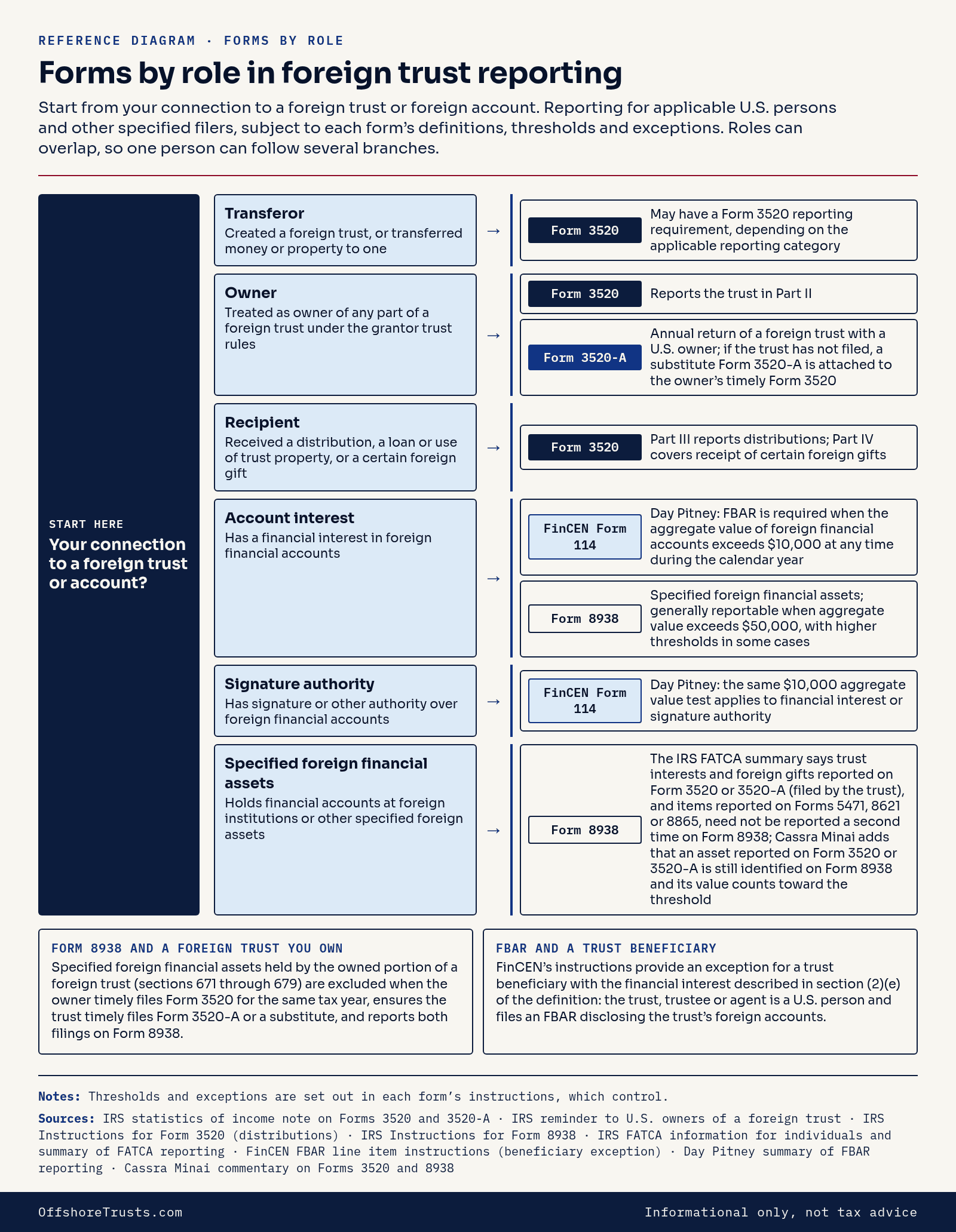
Data table for this infographic
| Role or topic | Connection or condition | Form or reporting | Details |
|---|---|---|---|
| Start here | Your connection to a foreign trust or account? | Roles can overlap, so one person can follow several branches. | |
| Transferor | Created a foreign trust, or transferred money or property to one | Form 3520 | May have a Form 3520 reporting requirement, depending on the applicable reporting category |
| Owner | Treated as owner of any part of a foreign trust under the grantor trust rules | Form 3520 | Reports the trust in Part II |
| Owner | Treated as owner of any part of a foreign trust under the grantor trust rules | Form 3520-A | Annual return of a foreign trust with a U.S. owner; if the trust has not filed, a substitute Form 3520-A is attached to the owner's timely Form 3520 |
| Recipient | Received a distribution, a loan or use of trust property, or a certain foreign gift | Form 3520 | Part III reports distributions; Part IV covers receipt of certain foreign gifts |
| Account interest | Has a financial interest in foreign financial accounts | FinCEN Form 114 | Day Pitney: FBAR is required when the aggregate value of foreign financial accounts exceeds $10,000 at any time during the calendar year |
| Account interest | Has a financial interest in foreign financial accounts | Form 8938 | Specified foreign financial assets; generally reportable when aggregate value exceeds $50,000, with higher thresholds in some cases |
| Signature authority | Has signature or other authority over foreign financial accounts | FinCEN Form 114 | Day Pitney: the same $10,000 aggregate value test applies to financial interest or signature authority |
| Specified foreign financial assets | Holds financial accounts at foreign institutions or other specified foreign assets | Form 8938 | Trust interests and foreign gifts reported on Form 3520 or 3520-A, and items reported on Forms 5471, 8621 or 8865, need not be reported a second time on Form 8938. The other forms are still identified on Form 8938, and the asset's value counts toward the threshold. |
| Form 8938 and a foreign trust you own | Treated as owner of any part of a foreign trust under the grantor trust rules | Form 8938 | Specified foreign financial assets held by the owned portion of a foreign trust (sections 671 through 679) are excluded when the owner timely files Form 3520 for the same tax year, ensures the trust timely files Form 3520-A or a substitute, and reports both filings on Form 8938. |
| FBAR and a trust beneficiary | Trust beneficiary with a financial interest in the trust's foreign financial accounts | FinCEN Form 114 | FinCEN's instructions provide an exception for a trust beneficiary with the financial interest described in section (2)(e) of the definition: the trust, trustee or agent is a U.S. person and files an FBAR disclosing the trust's foreign accounts. |
Notes: Thresholds and exceptions are set out in each form’s instructions, which control.
Sources: IRS statistics of income note on Forms 3520 and 3520-A · IRS reminder to U.S. owners of a foreign trust · IRS Instructions for Form 3520 (distributions) · IRS Instructions for Form 8938 · IRS FATCA information for individuals and summary of FATCA reporting · FinCEN FBAR line item instructions (beneficiary exception) · Day Pitney summary of FBAR reporting · Cassra Minai commentary on Forms 3520 and 8938 · OffshoreTrusts.com
Questions and answers
What does Form 3520 report for a foreign trust?
It covers certain transfers to foreign trusts and distributions received from them. Payments from trust accounts can also count as constructive distributions.[1]
What is Form 3520-A for?
It is the annual information return of a foreign trust with at least one U.S. owner. It provides information about the trust, U.S. beneficiaries, and persons treated as owners under the grantor trust rules.[7]
When is Form 3520-A due?
The trust generally files it by the 15th day of the third month after its tax year ends, unless an extension applies. A weekend or legal holiday pushes the due date to the next business day. If the trust fails to file, the U.S. owner completes a substitute and attaches it to Form 3520 by that form's due date.[2][7]
Can a trust's payment of a credit card bill count as a distribution?
Yes. The instructions treat charges paid by a foreign trust as distributions to the taxpayer. They also treat checks written on a foreign trust's bank account as distributions.[1]
Does every foreign trust payment count as a distribution?
Gratuitous transfers and certain constructive transfers count as distributions. For a payment exchanged for property or services, the excess over the fair market value of what was provided is treated as a distribution.[1]
Does reporting an asset on Form 3520 always mean it is excluded from Form 8938?
Reporting an asset on Form 3520 does not automatically exclude it from Form 8938: relief from duplicate reporting applies to specified foreign financial assets reported on qualifying forms for the same tax year, and Form 8938 must identify the forms by indicating how many were filed. A separate rule describes assets held by an owned portion of a foreign trust when specified filing and Form 8938 reporting conditions are satisfied.[4][6]
Related resources
Related glossary terms
- Foreign trust classification: A trust is foreign under Form 3520 when it fails either domestic trust test. The tests ask about U.S. court supervision and control of substantial decisions.
- Foreign grantor trust owner statement: The Instructions for Form 3520-A identify the Foreign Grantor Trust Owner Statement as pages 3 and 4 of the foreign trust's annual information return.
- Section 679: Section 679 addresses certain transfers by U.S. persons to foreign trusts. It treats some property transfers as ownership when the trust has a U.S. beneficiary.
Related articles and guides
- IRS Foreign Trust Reporting Requirements: An IRS reference page on foreign trust reporting, income tax rules, Forms 3520 and 3520-A, and related U.S. reporting for citizens and other U.S. persons.
- Section 6048 reporting for certain foreign trusts: Section 6048 foreign trust reporting for U.S. citizens, including definitions and reportable events, as well as ownership and distributions and the IRS forms.
- Hong Kong information exchange and U.S. trust reporting: Hong Kong's framework for exchanging financial account information and its FATCA agreement status, with the IRS reporting rules for foreign trust owners.
Tools and official documents
- Form 3520-A: annual information return of a foreign trust: Form 3520-A is a foreign trust's annual information return for a U.S. owner: ownership, annual statements, attachments, related forms and filing timing.
- IRS and FinCEN forms: reference pages: Reference pages for 15 IRS and FinCEN forms tied to foreign trusts, foreign accounts and entities, built from the official forms and their instructions.
Related pages
Sources and data notes
- irs.gov, Instructions for Form 3520 (12/2025) | Internal Revenue Service. https://www.irs.gov/instructions/i3520. Retrieved .
- irs.gov, U.S. citizens and residents abroad, Filing requirements | Internal Revenue Service. https://www.irs.gov/individuals/international-taxpayers/us-citizens-and-residents-abroad-filing-requirements. Retrieved .
- irs.gov, Foreign trust reporting requirements and tax consequences | Internal Revenue Service. https://www.irs.gov/businesses/international-businesses/foreign-trust-reporting-requirements-and-tax-consequences. Retrieved .
- irs.gov, Instructions for Form 8938 (11/2021) | Internal Revenue Service. https://www.irs.gov/instructions/i8938. Retrieved .
- irs.gov, Reminder to U.S. owners of a foreign trust | Internal Revenue Service. https://www.irs.gov/individuals/international-taxpayers/reminder-to-us-owners-of-a-foreign-trust. Retrieved .
- irs.gov, Summary of FATCA reporting for U.S taxpayers | Internal Revenue Service. https://www.irs.gov/businesses/corporations/summary-of-fatca-reporting-for-us-taxpayers. Retrieved .
- irs.gov, Instructions for Form 3520-A (12/2025) | Internal Revenue Service. https://www.irs.gov/instructions/i3520a. Retrieved .
- irs.gov, Form 3520 (2010). https://www.irs.gov/pub/irs-prior/f3520--2010.pdf. Retrieved .
- irs.gov, Form 3520 (2021). https://www.irs.gov/pub/irs-prior/f3520--2021.pdf. Retrieved .
- law.cornell.edu, 26 U.S. Code § 6048, Information with respect to certain foreign trusts. https://www.law.cornell.edu/uscode/text/26/6048. Retrieved .
- irs.gov, 8.11.5 International Penalties | Internal Revenue Service. https://www.irs.gov/irm/part8/irm_08-011-005. Retrieved .
- govinfo.gov, Federal Register, Volume 89 Issue 90 (Wednesday, May 8, 2024). https://www.govinfo.gov/content/pkg/FR-2024-05-08/html/2024-09434.htm. Retrieved .
Dates in this block record when each source was read for this page.