
FBAR and Form 8938 for accounts linked to trusts
For a U.S. citizen, FBAR and Form 8938 are separate reports with different filing tests. The IRS instructions describe when foreign accounts and interests tied to a foreign trust may enter those tests.
When FBAR applies
A U.S. citizen is a U.S. person for FBAR purposes, and the FBAR rule applies when there is a financial interest in or authority over a foreign financial account and aggregate foreign account values exceed $10,000 at any time during the calendar year. The account test is not based on whether the account produced taxable income.[7]
A foreign account can include a bank, brokerage, or mutual fund account held outside the United States. A beneficiary need not report foreign financial accounts held by a trust if a U.S. person that is the trust, its trustee, or its agent files an FBAR reporting those accounts.[1][7]
The FBAR is submitted electronically through FinCEN's BSA E-Filing System and is separate from a federal income tax return. It is an annual report due April 15 after the reported calendar year, with an automatic extension to October 15.[7]
When Form 8938 applies
A U.S. citizen is a specified individual under the Form 8938 instructions. A specified individual with an interest in specified foreign financial assets files Form 8938 when their aggregate value is above the applicable threshold, provided an exception does not apply.
Specified foreign financial assets include foreign financial accounts and foreign assets held for investment outside an account. A foreign trust owner may have to report assets held by the trust, and a beneficiary may have to report an interest in the trust. A beneficial interest is excluded when the person does not know, and has no reason to know, of it; receiving a distribution counts as knowledge under the IRS summary.[2][5]
For a U.S. citizen living in the United States, the instructions state a $50,000 threshold at year end or $75,000 at any time for an unmarried person or a person filing separately. For married people filing jointly, the amounts are $100,000 at year end or $150,000 at any time. Higher thresholds apply for individuals living outside the United States.[5]
Form 8938 is attached to the applicable annual return. For a trust owner, the instructions describe an exception for assets of the owned portion when the trust is reported on Form 3520, the individual files timely, and the trust files Form 3520-A timely. Assets reported on specified other forms can be excluded from duplicate listing, though their values remain part of the reporting threshold calculation.[2][5]
How the two reports differ
FBAR focuses on foreign financial accounts and uses the $10,000 aggregate account threshold, together with a financial interest or account authority test. Form 8938 covers specified foreign financial assets, including qualifying non-account assets and some foreign trust interests, and uses thresholds that vary with residence and filing status.[5][7]
Filing Form 8938 does not satisfy an FBAR filing requirement. An account can be reportable on both forms, while a specified foreign financial asset held outside a financial account is reported on Form 8938 and not on the FBAR. The IRS says the forms use different definitions and reporting requirements.[2][5]
Penalties for missed reports
The FBAR carries civil penalties that scale with willfulness. A non-willful failure can draw a penalty per violation, and no penalty applies when there is reasonable cause and the balance is properly reported. A willful failure can draw the greater of an inflation-adjusted amount (set at $100,000 in the statute) or 50% of the account balance at the time of the violation, and willful violations can also carry criminal exposure.[7]
A Form 8938 that is not filed complete and correct by the due date can draw a $10,000 penalty. If the failure continues 90 days after the IRS mails a notice, a further $10,000 applies for each 30-day period, up to $50,000 of additional penalty. An underpayment tied to an undisclosed foreign financial asset can also bear a 40% accuracy-related penalty in place of the usual 20%.[2]
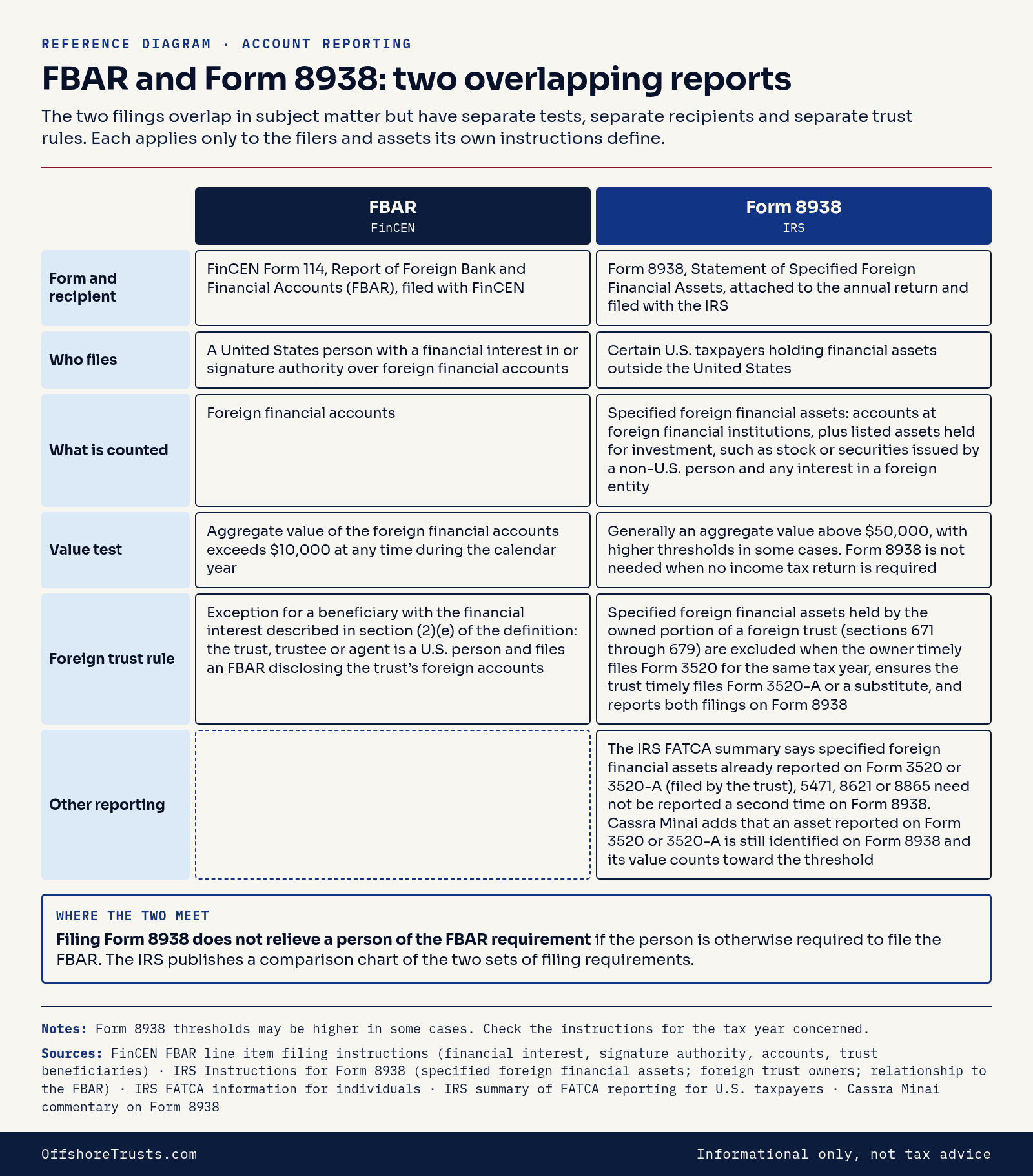
Data table for this infographic
| Topic | FBAR | Form 8938 |
|---|---|---|
| Summary | The two filings overlap in subject matter but have separate tests, separate recipients and separate trust rules. | |
| Form and recipient | FinCEN Form 114, Report of Foreign Bank and Financial Accounts (FBAR), filed with FinCEN | Form 8938, Statement of Specified Foreign Financial Assets, attached to the annual return and filed with the IRS |
| Who files | A United States person with a financial interest in or signature authority over foreign financial accounts | Certain U.S. taxpayers holding financial assets outside the United States |
| What is counted | Foreign financial accounts | Specified foreign financial assets: accounts at foreign financial institutions, plus listed assets held for investment, such as stock or securities issued by a non-U.S. person and any interest in a foreign entity |
| Value test | Aggregate value of the foreign financial accounts exceeds $10,000 at any time during the calendar year | Generally an aggregate value above $50,000, with higher thresholds in some cases. Form 8938 is not needed when no income tax return is required |
| Foreign trust rule | Exception for a beneficiary whose financial interest in a trust account rests on a present beneficial interest in more than 50 percent of the trust assets or current income: no filing is needed when the trust, trustee or agent is a U.S. person and files an FBAR disclosing the trust's foreign accounts | Specified foreign financial assets held by the owned portion of a foreign trust (sections 671 through 679) are excluded when the owner timely files Form 3520 for the same tax year, ensures the trust timely files Form 3520-A or a substitute, and reports both filings on Form 8938 |
| Other reporting | Specified foreign financial assets already reported on Form 3520 or 3520-A (filed by the trust), 5471, 8621 or 8865 need not be reported a second time on Form 8938. The asset is still identified on Form 8938, and its value counts toward the threshold. | |
| Where the two meet | Filing Form 8938 does not relieve a person of the FBAR requirement if the person is otherwise required to file the FBAR. The IRS publishes a comparison chart of the two sets of filing requirements. | |
| Notes | Form 8938 thresholds may be higher in some cases. The instructions for the tax year concerned govern. | |
| Sources | FinCEN FBAR line item filing instructions (financial interest, signature authority, accounts, trust beneficiaries) · IRS Instructions for Form 8938 (specified foreign financial assets; foreign trust owners; relationship to the FBAR) · IRS FATCA information for individuals · IRS summary of FATCA reporting for U.S. taxpayers · Cassra Minai commentary on Form 8938 | |
Questions and answers
Does an FBAR threshold depend on whether a foreign account earned income?
No. The IRS says whether an account produced taxable income does not affect whether it is a foreign financial account for FBAR purposes. The filing test instead refers to financial interest or authority and the aggregate value threshold.[7]
Can a foreign trust beneficiary have an FBAR filing exception for trust accounts?
Yes. When a U.S. person that is the trust, its trustee or its agent files an FBAR reporting the trust's foreign financial accounts, a beneficiary need not report those accounts.[7]
Does a foreign trust interest go on Form 8938?
It may. The instructions say an owner of a foreign grantor trust may have to report assets held by the trust, and a beneficiary may have to report their trust interest. A beneficiary interest is excluded in the IRS summary when the person does not know or have reason to know of it.[2][5]
What is the Form 8938 threshold for an unmarried U.S. resident?
For an unmarried U.S. resident, the threshold is more than $50,000 on the last day of the tax year or more than $75,000 at any time during it. The person must also be required to file an income tax return for the year.[2][5]
Are FBAR and Form 8938 filed with the same return?
No. The FBAR is filed electronically through FinCEN's BSA E-Filing System and is not filed with a federal tax return. Form 8938 goes with the applicable annual return.[2][7]
Does reporting trust assets on another form remove them from the Form 8938 threshold calculation?
No. Some assets reported on listed forms need not be listed a second time on Form 8938, but their value remains included in determining whether the threshold is met.[5]
Related resources
Related glossary terms
- FBAR: FinCEN describes the FBAR filing rule for U.S. persons with foreign accounts. It covers the $10,000 aggregate threshold, account interests and exceptions.
- Responsible party: The Instructions for Form 3520 define the responsible party for specified events involving a foreign trust. The role differs from an owner or U.S. agent.
- Foreign grantor trust: A foreign grantor trust is a foreign trust treated as owned by a grantor, often a U.S. person. Ownership brings Form 3520 and Form 3520-A reporting duties.
Related articles and guides
- PFIC holdings and trust reporting: PFIC classification tests and related reporting apply to U.S. citizens with direct or indirect interests, including interests held through foreign trusts.
- Trust accounts: FBAR and Form 8938 overlap: Trust-related FBAR and Form 8938 reporting: foreign accounts and specified assets, ownership, signature authority, and where the two reports overlap and differ.
Tools and official documents
- Form 1116: foreign tax credit: Form 1116 claims the foreign tax credit for U.S. citizens: income categories, supporting information, related forms and filing timing under the instructions.
- Form 8865: foreign partnerships: Form 8865 reports U.S. persons' interests in certain foreign partnerships: filer categories, definitions, schedules, related forms and timing for citizens.
Related pages
Sources and data notes
- irs.gov, Foreign trust reporting requirements and tax consequences | Internal Revenue Service. https://www.irs.gov/businesses/international-businesses/foreign-trust-reporting-requirements-and-tax-consequences. Retrieved .
- irs.gov, Instructions for Form 8938 (11/2021) | Internal Revenue Service. https://www.irs.gov/instructions/i8938. Retrieved .
- irs.gov, Reminder to U.S. owners of a foreign trust | Internal Revenue Service. https://www.irs.gov/individuals/international-taxpayers/reminder-to-us-owners-of-a-foreign-trust. Retrieved .
- irs.gov, FATCA information for individuals | Internal Revenue Service. https://www.irs.gov/businesses/corporations/fatca-information-for-individuals. Retrieved .
- irs.gov, Summary of FATCA reporting for U.S taxpayers | Internal Revenue Service. https://www.irs.gov/businesses/corporations/summary-of-fatca-reporting-for-us-taxpayers. Retrieved .
- irs.gov, Summary of key FATCA provisions | Internal Revenue Service. https://www.irs.gov/businesses/corporations/summary-of-key-fatca-provisions. Retrieved .
- irs.gov, Report of Foreign Bank and Financial Accounts (FBAR) | Internal Revenue Service. https://www.irs.gov/businesses/small-businesses-self-employed/report-of-foreign-bank-and-financial-accounts-fbar. Retrieved .
- irs.gov, 4.26.16 Report of Foreign Bank and Financial Accounts (FBAR) | Internal Revenue Service. https://www.irs.gov/irm/part4/irm_04-026-016. Retrieved .
- irs.gov, Instructions for Form 8621 (12/2025) | Internal Revenue Service. https://www.irs.gov/instructions/i8621. Retrieved .
- irs.gov, How to report foreign bank and financial accounts | Internal Revenue Service. https://www.irs.gov/newsroom/how-to-report-foreign-bank-and-financial-accounts. Retrieved .
- fincen.gov, Reminder of Requirement to File Report of Foreign Bank and Financial Accounts Form TD F 90-22.1 ("FBAR"). https://www.fincen.gov/resources/statutes-regulations/guidance/reminder-requirement-file-report-foreign-bank-and-financial. Retrieved .
- irs.gov, 5.21.3 Collection Tools for International Cases | Internal Revenue Service. https://www.irs.gov/irm/part5/irm_05-021-003. Retrieved .
Dates in this block record when each source was read for this page.