
Form 8938: specified foreign financial assets
Form 8938 reports specified foreign financial assets, and its instructions cover reporting thresholds, asset definitions, required information and filing timing.
What Form 8938 reports
Form 8938 reports specified foreign financial assets when their combined value exceeds the applicable reporting threshold. The IRS describes the test by reference to all such assets in which the filer has an interest.[1]
The instructions apply the filing requirement to a specified person with relevant assets above the threshold, unless an exception applies. When Form 8938 is required, reporting includes relevant assets even when those assets have no effect on the tax liability for the reporting year.[2]
Who the instructions cover
A U.S. citizen falls within the instructions' specified individual category. That category also includes resident aliens for any part of the tax year, subject to the reporting-period rules, and certain nonresident aliens described in the instructions.[2]
The instructions also cover specified domestic entities, including certain domestic corporations and partnerships, as well as trusts formed or used to hold specified foreign financial assets. Their stated reporting threshold is more than $50,000 at tax-year end or more than $75,000 at any point during the tax year.[2]
An individual without an income tax return filing requirement has no Form 8938 filing requirement for that tax year. The instructions retain this exception even when the assets exceed the relevant threshold.[2]
Reporting thresholds for individuals
Individual thresholds depend on marital status, joint or separate filing, and residence inside or outside the United States. Each threshold has a tax-year-end test and a separate test for value reached at any point during the tax year.[2]
| Residence and filing status | Tax-year-end value | Value at any time |
|---|---|---|
| United States, unmarried | More than $50,000 | More than $75,000[2] |
| United States, married filing jointly | More than $100,000 | More than $150,000[2] |
| United States, married filing separately | More than $50,000 | More than $75,000[2] |
| Outside United States, unmarried or married filing separately | More than $200,000 | More than $300,000[2] |
| Outside United States, married filing jointly | More than $400,000 | More than $600,000[2] |
The outside-U.S. thresholds require a foreign tax home and satisfaction of a presence-abroad test. For a U.S. citizen, the tests include bona fide foreign residence for an uninterrupted period containing an entire tax year, or presence abroad for at least 330 full days within a qualifying period of 12 consecutive months.[2]
Asset and interest definitions
Specified foreign financial assets include accounts maintained by foreign financial institutions. The financial-account definition covers deposit and custodial accounts, certain equity or debt interests in foreign financial institutions, and cash-value life insurance or annuity contracts maintained by the institutions described in the instructions.[2]
Outside financial accounts, the definition includes investment assets such as foreign-issued shares, foreign partnership interests, foreign debt instruments, and interests in foreign trusts or estates. For this purpose, an investment asset is generally one that is neither used nor held for use in conducting a trade or business.[2]
An interest exists when holding or disposing of an asset produces, or would produce, items reportable on the individual's income tax return. The definition still applies when no such item appears on the return for that tax year.[2]
An owner of a disregarded entity has an interest in its specified foreign financial assets. A reportable account does not require separate reporting of the assets within it.[2]
Valuation and jointly owned assets
The instructions generally use fair market value and ask for each reported asset's maximum value during the tax year. A third-party appraisal is unnecessary to estimate that maximum.[2]
Foreign-currency assets are valued in their currency before conversion into U.S. dollars. The general conversion rule uses the tax-year-end exchange rate, with an exception permitting reliance on the conversion rate in a financial institution's account statement issued at least annually.[2]
Spouses filing jointly count a jointly owned asset once when testing the threshold. Specified-individual spouses filing separately each count half its value for that test, although each reports the entire maximum value on a required separate Form 8938.[2]
Information and attachments
Form 8938 asks for identifying information matching the accompanying annual return, including the filer's name and taxpayer identification number. Part I summarizes foreign deposit and custodial accounts, while Part II summarizes other reportable accounts and assets.[2]
Part III links tax items attributable to reported assets with the schedules, forms, or returns carrying those items. Its categories include interest, dividends, royalties, other income, gains or losses, deductions, and credits.[2]
Part V requests account identifiers, maximum values, currency-conversion information, and the financial institution's name and mailing address. Part VI requests asset descriptions and identifiers, relevant transaction timing, value information, and details of the foreign entity or issuer or counterparty.[2]
Additional accounts, assets, issuers, or counterparties can require extra copies of page 2. The instructions call for attaching those copies, marking the additional-statements box, and entering the number of statements.[2]
Relationship to other reporting forms
Form 8938 leaves any separate FBAR filing requirement in place. The instructions identify that report as FinCEN Form 114.[2]
Assets reported on timely filed Forms 3520, 5471, 8621, or 8865 for the same tax year can qualify for an exception from duplicate asset reporting. Part IV records the relevant form types and counts, while specified individuals still include the assets' values in their threshold calculation.[2]
For a foreign grantor trust owner, the stated exception requires timely Form 3520 reporting and timely filing of Form 3520-A by the trust, or a timely substitute filed by the owner. Reporting those filings on Form 8938 is also a condition.[2]
Filing timing and reporting period
Form 8938 accompanies the annual return and shares that return's filing deadline, including extensions. The instructions direct filers to attach it to an annual or amended return instead of submitting it alone.[2]
The reporting period generally matches the filer's tax year. When specified-individual status covers only part of that year, the instructions limit the reporting period to that part.[2]
Penalties for late or incomplete filing
A Form 8938 that is not filed complete and correct by the due date can draw a $10,000 penalty. If the failure continues 90 days after the IRS mails a notice, a further $10,000 applies for each 30-day period, up to $50,000 of additional penalty. An underpayment tied to an undisclosed foreign financial asset can also bear a 40% accuracy-related penalty in place of the usual 20%.[2]
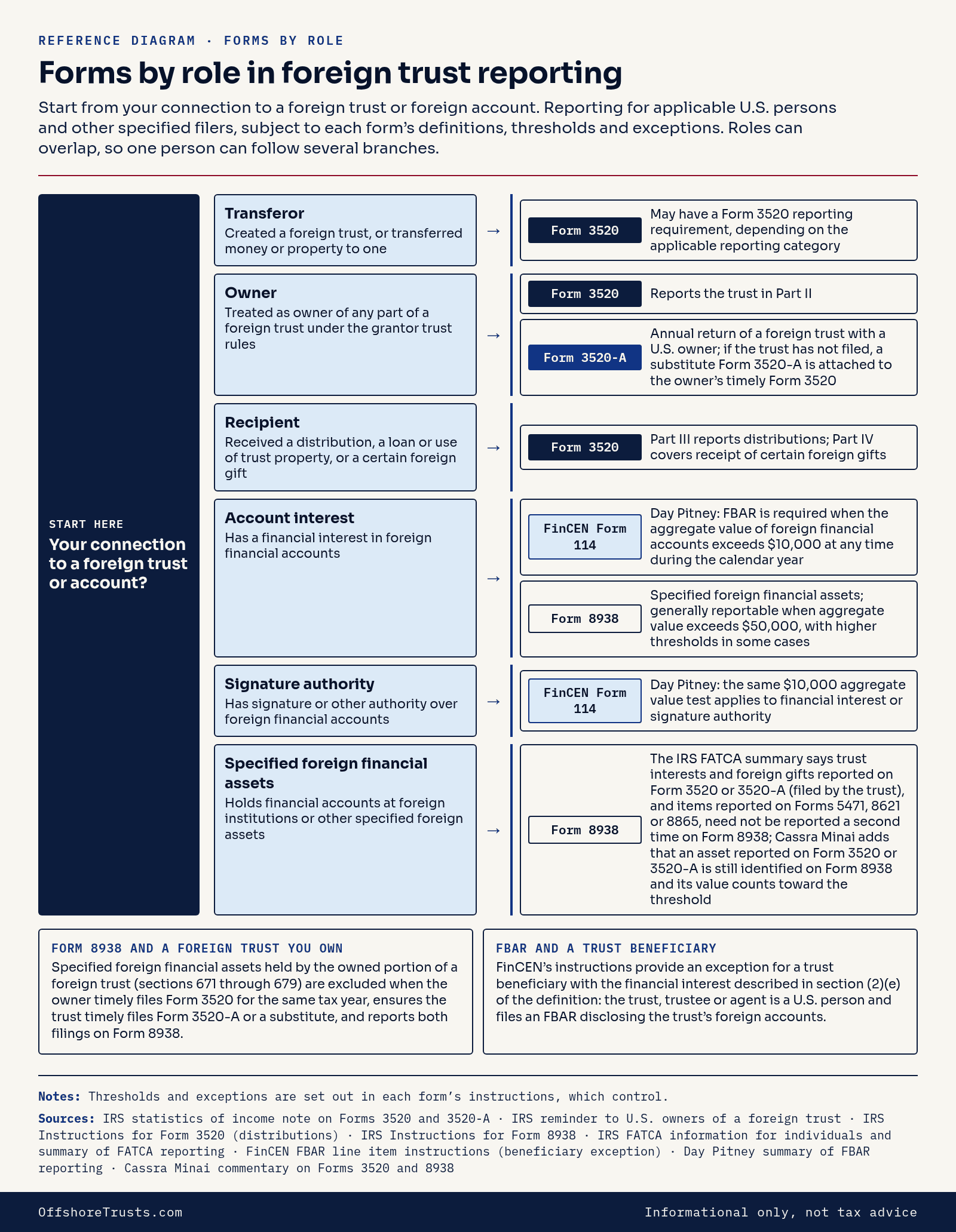
Data table for this infographic
| Role or topic | Connection or condition | Form or reporting | Details |
|---|---|---|---|
| Start here | Your connection to a foreign trust or account? | Roles can overlap, so one person can follow several branches. | |
| Transferor | Created a foreign trust, or transferred money or property to one | Form 3520 | May have a Form 3520 reporting requirement, depending on the applicable reporting category |
| Owner | Treated as owner of any part of a foreign trust under the grantor trust rules | Form 3520 | Reports the trust in Part II |
| Owner | Treated as owner of any part of a foreign trust under the grantor trust rules | Form 3520-A | Annual return of a foreign trust with a U.S. owner; if the trust has not filed, a substitute Form 3520-A is attached to the owner's timely Form 3520 |
| Recipient | Received a distribution, a loan or use of trust property, or a certain foreign gift | Form 3520 | Part III reports distributions; Part IV covers receipt of certain foreign gifts |
| Account interest | Has a financial interest in foreign financial accounts | FinCEN Form 114 | Day Pitney: FBAR is required when the aggregate value of foreign financial accounts exceeds $10,000 at any time during the calendar year |
| Account interest | Has a financial interest in foreign financial accounts | Form 8938 | Specified foreign financial assets; generally reportable when aggregate value exceeds $50,000, with higher thresholds in some cases |
| Signature authority | Has signature or other authority over foreign financial accounts | FinCEN Form 114 | Day Pitney: the same $10,000 aggregate value test applies to financial interest or signature authority |
| Specified foreign financial assets | Holds financial accounts at foreign institutions or other specified foreign assets | Form 8938 | Trust interests and foreign gifts reported on Form 3520 or 3520-A, and items reported on Forms 5471, 8621 or 8865, need not be reported a second time on Form 8938. The asset is still identified on Form 8938, and its value counts toward the threshold. |
| Form 8938 and a foreign trust you own | Treated as owner of any part of a foreign trust under the grantor trust rules | Form 8938 | Specified foreign financial assets held by the owned portion of a foreign trust (sections 671 through 679) are excluded when the owner timely files Form 3520 for the same tax year, ensures the trust timely files Form 3520-A or a substitute, and reports both filings on Form 8938. |
| FBAR and a trust beneficiary | Beneficiary of a trust with a financial interest described in section (2)(e) of the definition | FinCEN Form 114 | FinCEN's instructions provide an exception for a trust beneficiary with the financial interest described in section (2)(e) of the definition: the trust, trustee or agent is a U.S. person and files an FBAR disclosing the trust's foreign accounts. |
Notes: Thresholds and exceptions are set out in each form’s instructions, which control.
Sources: IRS statistics of income note on Forms 3520 and 3520-A · IRS reminder to U.S. owners of a foreign trust · IRS Instructions for Form 3520 (distributions) · IRS Instructions for Form 8938 · IRS FATCA information for individuals and summary of FATCA reporting · FinCEN FBAR line item instructions (beneficiary exception) · Day Pitney summary of FBAR reporting · Cassra Minai commentary on Forms 3520 and 8938 · OffshoreTrusts.com
Questions and answers
Does U.S. citizenship alone create a Form 8938 filing requirement?
Citizenship places an individual in the specified individual category. Filing also depends on relevant asset interests, the applicable value threshold, and exceptions, including the exception for individuals without an income tax return filing requirement.[2]
Are accounts maintained by U.S. financial institutions included?
The instructions exclude accounts maintained by a U.S. payer from specified foreign financial assets. Their examples include brokerage accounts maintained by U.S. financial institutions.[2]
Does reporting a foreign pension require listing its underlying assets?
The instructions place the interest in a foreign pension or foreign deferred compensation plan in Part VI. They do not require separate reporting of the plan's underlying assets.[2]
Does foreign social security count as a specified foreign financial asset?
The instructions exclude rights to foreign benefits equivalent to U.S. social security, social insurance, or similar government programs. They distinguish those benefits from an interest in a foreign pension plan, which remains subject to section 6038D reporting.[2]
Related resources
Related glossary terms
- Maximum account value: The Form 8938 instructions define maximum account value as a financial account's highest value during the tax year, based generally on fair market value.
- Reporting threshold for Form 8938: The Form 8938 instructions set asset value thresholds for specified individuals based on marital status, filing status, and qualifying residence abroad.
- Specified foreign financial asset: The Form 8938 instructions use specified foreign financial asset for certain foreign accounts and investment holdings. The term identifies assets for reporting.
Related articles and guides
- Form 8938 and Foreign Trust Assets: A U.S. citizen's guide to Form 8938: what counts as a specified foreign financial asset, when the form accompanies a tax return, and how filing thresholds vary.
- Rev. Proc. 2020-17 and foreign trust reporting: Rev. Proc. 2020-17 covers its scope, trust definitions and eligibility conditions, and its link to U.S. reporting for certain foreign trusts and U.S. persons.
Related pages
- IRS forms: All form reference pages.
- FinCEN Report 114 (FBAR): foreign account reporting
- Form 1041: income tax return for estates and trusts
- Form 1116: foreign tax credit
- Form 2555: foreign earned income exclusion
- IRS form finder: Search the forms by keyword.
- Self-directed IRAs, foreign assets and trust structures: Self-directed IRA structures that hold foreign assets: prohibited transactions, account reporting duties and where retirement account tax rules stop applying.
- Second citizenship and U.S. tax obligations: Understand how second citizenship affects a U.S. citizen's worldwide income reporting, foreign accounts, earned income exclusions and expatriation tax duties.
Sources and data notes
- Internal Revenue Service, About Form 8938. https://www.irs.gov/forms-pubs/about-form-8938. Retrieved .
- Internal Revenue Service, Instructions for Form 8938. https://www.irs.gov/instructions/i8938. Retrieved .
Dates in this block record when each source was read for this page.