

Trust forms and statutory regimes in the BVI
British Virgin Islands legislation sets out trust forms and statutory regimes. The legislation covers trustee and enforcer roles, duration rules, and income accumulation.
Trusts for people and for purposes
The Trustee Act distinguishes trusts for people from trusts for purposes. Its definition of a trust for any purpose excludes trusts for particular persons, whether immediately ascertainable or not, and trusts for an aggregate identified through personal relationships.[1]
A purpose trust may be charitable or non-charitable. For a valid non-charitable purpose trust under the Act, the purpose must be specific, reasonable, possible, and lawful. At least one trustee must be a designated person, and the instrument must appoint an enforcer and provide for a successor. The enforcer must be a party to the instrument or give written consent addressed to the designated trustee.[1]
The Act defines the enforcer's statutory role in a purpose trust. One person cannot serve as both trustee and enforcer of that trust. A trustee must provide the enforcer with trust accounts and copies of the trust instrument and related instruments.[1]
The statute says charitable trusts remain governed by existing law, and an enforcer appointment for a charitable trust has no effect.
Powers reserved in the trust instrument
A trust instrument may confer specified powers on the settlor or another person without that person becoming a trustee solely by exercising those powers. The Act names a protector or nominator as possible labels, and permits powers to change the proper law, change the forum of administration, remove trustees, appoint trustees, and change who may benefit.[1]
The statute also permits a power to withhold consent from specified trustee actions, conditionally or unconditionally. These provisions describe powers that may be written into a trust instrument; the specific terms depend on the instrument.[1]
VISTA trusts and company shares
The Virgin Islands Special Trusts Act provides a regime that may apply where a trust instrument directs that the Act's provisions govern specified Virgin Islands shares. The trust must be created by written instrument, have at least one designated trustee, and maintain one for as long as the direction has effect.[2]
Under the regime, the trustee holds designated shares on trust to retain them, subject to the Act's terms. The Act restricts use of share voting powers to interfere in the company's management and assigns company business and dividend decisions to its directors. Trust terms may set rules for director appointment and removal, including requiring action on a third person's or committee's decision.[2]
Duration and accumulation
Under amendments effective in 2013, the maximum perpetuity period for trusts created on or after commencement is 360 years. The earlier maximum was 100 years.[1]
The Act exempts a qualifying purpose trust from rules against excessive duration, including rules against perpetual trusts. The purpose trust instrument may state an event or date on which the trust ceases to be a purpose trust, and it may also set out how the trust's assets are to be disposed of at that point.[1]
Income may be accumulated for the duration of the trust period unless the trust terms prohibit accumulation or direct or authorize it for a shorter period.
British Virgin Islands trust legislation explained
The Trustee Act is the principal general statute addressing trusts and trustees in the British Virgin Islands. It covers trustee and court powers, trust duration, governing law, purpose trusts, and charities. The separate Virgin Islands Special Trusts Act addresses trusts holding shares in companies.[1][2]
The Trustee Act defines a trust as a legal relationship created when a settlor places assets under a trustee's control for a beneficiary or special purpose. The assets form a separate fund, title is held by the trustee or on the trustee's behalf, and the trustee must manage or deal with them under the trust terms and law. Reserved powers held by a settlor do not necessarily conflict with the trust's existence.[1]
Part V lists court powers concerning trustee appointments and remuneration, vesting orders, trust variations, and dealings with trust property. Part VII addresses perpetuity periods, powers of appointment, administrative powers and accumulation of income. Part VIII covers proper law, court jurisdiction, conflict of laws, purpose trusts, trustee decision making, protectors, managing trustees, and successor trustees. Part I requires trustees to retain trust records and underlying documentation for at least five years, in a form that explains transactions and allows the trust's financial position to be determined with reasonable accuracy.[1]
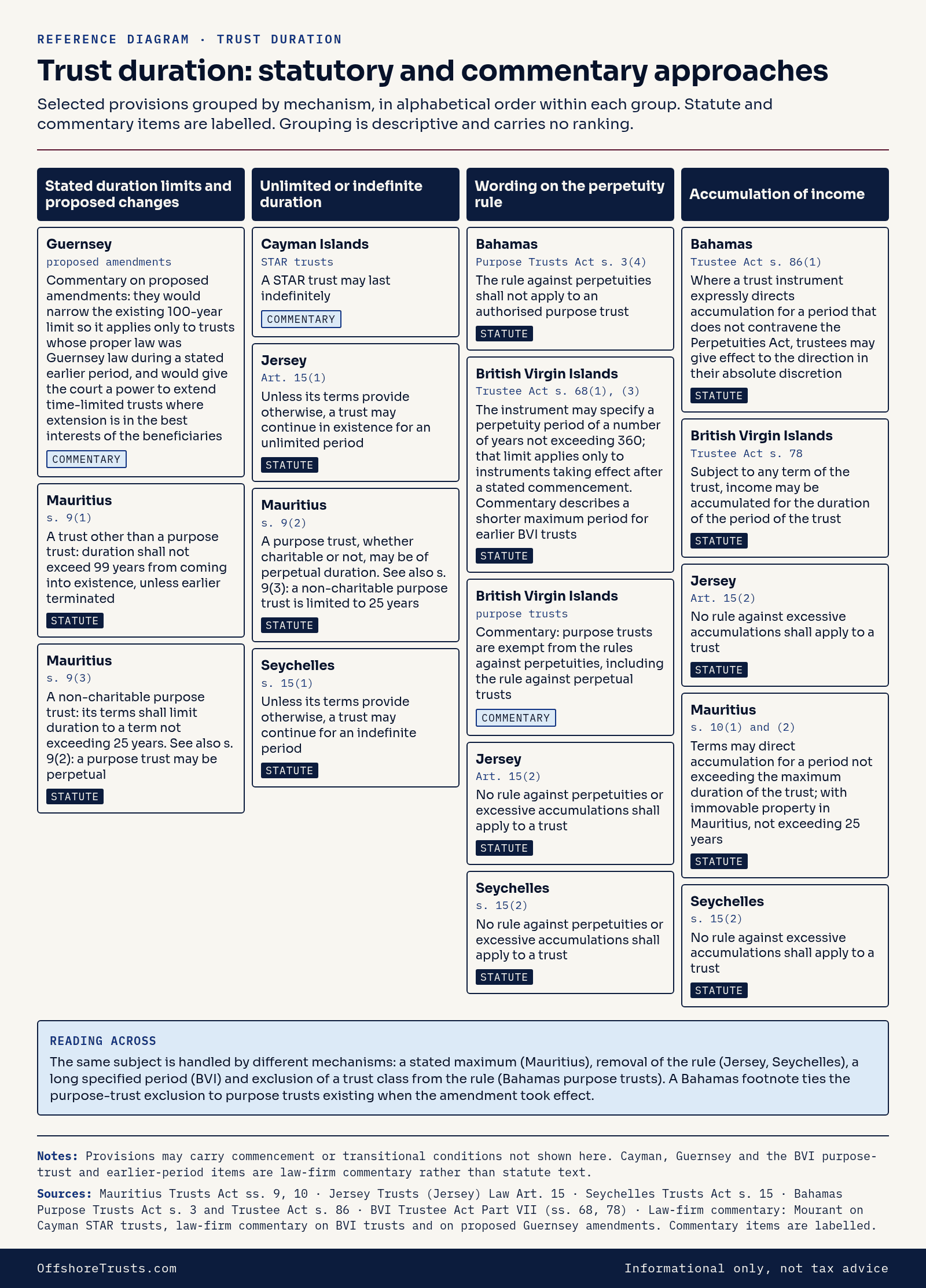
Data table for this infographic
| Mechanism | Jurisdiction | Provision or form | Description | Source type |
|---|---|---|---|---|
| Stated duration limits and proposed changes | Guernsey | proposed amendments | Commentary on proposed amendments: they would narrow the existing 100-year limit so it applies only to trusts whose proper law was Guernsey law during a stated earlier period, and would give the court a power to extend time-limited trusts where extension is in the best interests of the beneficiaries | commentary |
| Stated duration limits and proposed changes | Mauritius | s. 9(1) | A trust other than a purpose trust: duration shall not exceed 99 years from coming into existence, unless earlier terminated | statute |
| Unlimited or indefinite duration | Cayman Islands | STAR trusts | A STAR trust may last indefinitely | commentary |
| Unlimited or indefinite duration | Jersey | Art. 15(1) | Unless its terms provide otherwise, a trust may continue in existence for an unlimited period | statute |
| Unlimited or indefinite duration | Mauritius | s. 9(2) | A purpose trust, whether charitable or not, may be of perpetual duration (as amended in 2011) | statute |
| Unlimited or indefinite duration | Seychelles | s. 15(1) | Unless its terms provide otherwise, a trust may continue for an indefinite period | statute |
| Wording on the perpetuity rule | Bahamas | Purpose Trusts Act s. 3(4) | The rule against perpetuities shall not apply to an authorised purpose trust | statute |
| Wording on the perpetuity rule | British Virgin Islands | Trustee Act s. 68(1), (3) | The instrument may specify a perpetuity period of a number of years not exceeding 360; that limit applies only to instruments taking effect after a stated commencement. Commentary describes a shorter maximum period for earlier BVI trusts | statute |
| Wording on the perpetuity rule | British Virgin Islands | purpose trusts | Commentary: purpose trusts are exempt from the rules against perpetuities, including the rule against perpetual trusts | commentary |
| Wording on the perpetuity rule | Jersey | Art. 15(2) | No rule against perpetuities or excessive accumulations shall apply to a trust | statute |
| Wording on the perpetuity rule | Seychelles | s. 15(2) | No rule against perpetuities or excessive accumulations shall apply to a trust | statute |
| Accumulation of income | Bahamas | Trustee Act s. 86(1) | Where a trust instrument expressly directs accumulation for a period that does not contravene the Perpetuities Act, trustees may give effect to the direction in their absolute discretion | statute |
| Accumulation of income | British Virgin Islands | Trustee Act s. 78 | Subject to any term of the trust, income may be accumulated for the duration of the period of the trust | statute |
| Accumulation of income | Jersey | Art. 15(2) | No rule against excessive accumulations shall apply to a trust | statute |
| Accumulation of income | Mauritius | s. 10(1) and (2) | Terms may direct accumulation for a period not exceeding the maximum duration of the trust; with immovable property in Mauritius, not exceeding 25 years | statute |
| Accumulation of income | Seychelles | s. 15(2) | No rule against excessive accumulations shall apply to a trust | statute |
Reading across: The same subject is handled by different mechanisms: a stated maximum (Mauritius), removal of the rule (Jersey, Seychelles), a long specified period (BVI) and exclusion of a trust class from the rule (Bahamas purpose trusts). In The Bahamas, the purpose-trust exclusion is tied to purpose trusts existing when the amendment took effect.
Notes: Provisions may carry commencement or transitional conditions not shown here. The Cayman STAR trust item, the Guernsey proposed amendments item and the BVI purpose trust item are law-firm commentary and not statute text.
Sources: Mauritius Trusts Act ss. 9, 10 · Jersey Trusts (Jersey) Law Art. 15 · Seychelles Trusts Act s. 15 · Bahamas Purpose Trusts Act s. 3 and Trustee Act s. 86 · BVI Trustee Act Part VII (ss. 68, 78) · Law-firm commentary: Mourant on Cayman STAR trusts, law-firm commentary on BVI trusts and on proposed Guernsey amendments. Commentary items are labelled.
Attribution: OffshoreTrusts.com
Questions and answers
Can a BVI purpose trust have no individual beneficiaries?
Yes. The Trustee Act defines purpose trusts separately from trusts for particular persons or relationship-defined groups.
Who serves as enforcer of a non-charitable purpose trust?
The trust instrument must appoint an enforcer. The enforcer cannot also be a trustee of that purpose trust.[1]
Can a settlor reserve powers under a trust instrument?
Yes. The Act allows powers to be conferred on the settlor or another person, including powers concerning trustee appointments, beneficiaries, and the trust's governing law. Exercising specified powers alone does not make that person a trustee.[1]
How long may a BVI trust last?
For applicable dispositions, the instrument may specify a perpetuity period of up to 360 years under the statutory timing condition. A qualifying purpose trust is exempt from rules against excessive duration.[1]
Can trust income be accumulated throughout the trust period?
The Trustee Act says income may be accumulated for the trust period. This is subject to a trust term that prohibits accumulation or sets a shorter accumulation period.[1]
What does the VISTA statute say about trustee involvement in company management?
For designated shares, the trustee generally may not use voting or other powers to interfere in company management. The statute assigns business conduct and dividend decisions to company directors, subject to its provisions and the trust terms.[2]
Related resources
Related glossary terms
- Enforcer: An enforcer is a person given a role in relation to certain trusts. Jersey and Cayman law describe how enforcers are appointed, with their duties and rights.
- Settlor: A settlor is associated with creating a trust or placing property into it. Definitions describe the role through trust creation and property disposition.
- Reserved powers: Reserved powers are rights a settlor keeps, or gives to another person, under a trust. Trust laws address their validity and timing, and administration.
Related articles and guides
- Trust types and statutory regimes in The Bahamas: The Bahamas Trustee Act covers express and discretionary trusts, while the Purpose Trusts Act sets rules for authorised purpose trusts and their stated terms.
- Isle of Man trust law and statutory regimes: A reference to Isle of Man trust legislation for U.S. citizens, covering trustee roles, charitable trusts, reserved powers, and the statutory perpetuity period.
Related pages
- British Virgin Islands: overview: Start page for this jurisdiction.
- Trustee regulation and licensing
- Taxation of trusts
- Reporting and information exchange
Sources and data notes
- Government of the Virgin Islands; Attorney General's Chambers, Trustee Act. https://laws.gov.vg/sites/default/files/2024-07/Trustee%20Act.pdf. Retrieved .
- Government of the Virgin Islands; Attorney General's Chambers, Virgin Islands Special Trusts Act. https://laws.gov.vg/sites/default/files/consolidated_laws/2020/Virgin%20Islands%20Special%20Trusts%20Act.pdf. Retrieved .
- withersworldwide.com, Guiding you through VISTA trusts | Withers. https://www.withersworldwide.com/en-gb/insight/read/guiding-you-through-vista-trusts. Retrieved .
- withersworldwide.com, Trustees, Executors, Fiduciaries. https://www.withersworldwide.com/en-gb/experience/families-and-their-advisors/trustees-executors-and-fiduciaries. Retrieved .
- harneys.com, Comparison of key trust features for the British Virgin Islands and the Cayman Islands. https://www.harneys.com/insights/comparison-of-key-trust-features-for-the-british-virgin-islands-and-the-cayman-islands/. Retrieved .
- harneys.com, BVI trusts: purpose trusts. https://www.harneys.com/insights/bvi-trusts-purpose-trusts/. Retrieved .
- careyolsen.com, Private Client Guide 2026, British Virgin Islands (Legal 500) | Carey Olsen. https://www.careyolsen.com/insights/briefings/private-client-guide-2026-british-virgin-islands-legal-500. Retrieved .
- mourant.com, British Virgin Islands non-charitable purpose trusts, Mourant. https://www.mourant.com/guides/british-virgin-islands-non-charitable-purpose-trusts/. Retrieved .
- conyers.com, Shares in BVI Business Companies, Avoiding a Succession Problem, Conyers. https://www.conyers.com/publications/view/shares-in-bvi-business-companies-avoiding-succession-problem/. Retrieved .
- harneys.com, The use of British Virgin Islands Trusts in the Middle East. https://www.harneys.com/insights/the-use-of-british-virgin-islands-trusts-in-the-middle-east/. Retrieved .
- Attorney General's Chambers, Government of the Virgin Islands, Virgin Islands Laws Online. https://laws.gov.vg/. Retrieved .
Dates in this block record when each source was read for this page.